Quick picks:
- Best overall for beginners: Victorinox Fibrox Pro 8″ Chef’s Knife — light, grippy, forgiving, and the standard first proper chef’s knife
- Best budget: Mercer Culinary Millennia 8″ Chef’s Knife — real cutting performance for the least commitment
- Best step-up: Wüsthof Classic 8″ Chef’s Knife — forged, full-tang, and built to be your knife for decades
- Upgrade mention: Shun Classic 8″ Chef’s Knife (DM0706) — sharper and harder, but less forgiving while you learn
A first chef’s knife does not need to be expensive. It needs to be sharp, comfortable when your hands are wet, light enough that you stay in control, and forgiving while your technique is still forming — because it will be, and that is normal.
Beginners usually buy one extreme or the other: a flimsy knife that dulls in a month, or a hard, expensive knife they are afraid to maintain. These picks avoid both.
What matters in a first chef’s knife
- Grip before steel: You will cut onions with wet hands. A textured, non-slip handle is a safety feature, not a comfort extra.
- Weight: A lighter knife is easier to control while you learn grip and stroke. Heavy forged knives reward good technique; they do not teach it.
- Hardness (HRC): Softer steel dulls a little faster but is tougher and easier to sharpen. Harder steel holds a finer edge but can chip if you twist it, pry with it, or hit bone.
- Maintenance you will actually do: Every knife here needs hand washing, regular honing, and real sharpening when honing stops working. If that sounds like a chore you will skip, pick the more forgiving knife.
- Board and storage: Wood or soft plastic boards, never glass. Store on a strip, in a block, or with an edge guard — never loose in a drawer.
The picks
Best overall for beginners: Victorinox Fibrox Pro 8″ Chef’s Knife
Price: $46.00

This is the anchor pick, and the standard “first proper chef’s knife” recommendation for years. It is a stamped stainless blade — actual length about 7.9 inches — made in Switzerland, at roughly 6.4 ounces. That light weight is the point: it goes where you point it, and long sessions do not tire your hand.
The textured Fibrox handle — a non-slip thermoplastic — is the other half of the case. It stays secure with wet or greasy hands, and tolerates the rough handling a first knife gets while habits form. It will not win on looks, and stamped steel feels less dense than forged steel, but as a tool to learn on nothing here is as forgiving for the money.
One naming note: Victorinox’s current US page titles item 5.2063.20 “Fibrox Chef’s Knife Extra Wide, 8 in” rather than “Fibrox Pro” — same item number, so check the number if a listing’s name looks different.
Pros: Light and easy to control at ~6.4 oz; excellent wet grip; tough, forgiving blade for learning technique; Swiss-made.
Cons: Stamped blade feels less premium than forged; plain working-knife looks; edge still needs regular honing and periodic sharpening.
Best for: Almost every beginner — your first proper chef’s knife, full stop.
Best budget: Mercer Culinary Millennia 8″ Chef’s Knife
Price: $19.99
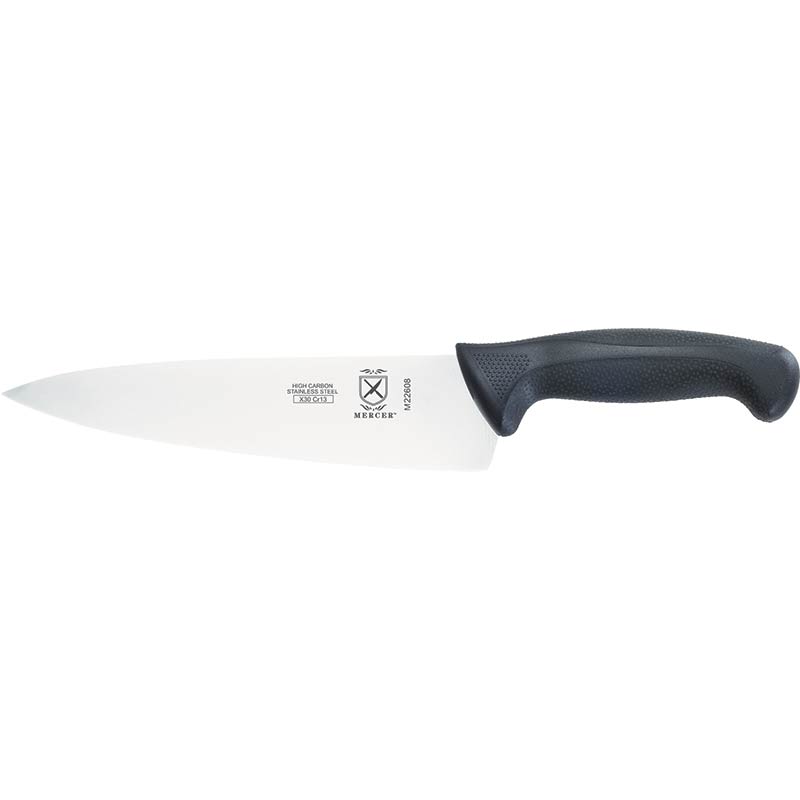
The Millennia is the knife line cooks reach for when a knife is a work tool, not a possession. Its high-carbon Japanese steel, at 53–54 HRC, is the softer, tougher end — exactly right while you learn: it takes an edge easily and sharpens without a fight.
You give up refinement: fit and finish are built to a price and to survive a commercial shift, and it needs honing more often than a harder knife. As a first knife — or one you hand to a helper without anxiety — it is hard to argue with. On a tight budget, start here and spend the difference on a honing rod and a decent board.
Pros: Lowest commitment here; tough 53–54 HRC steel that is easy to sharpen; designed for all-day working use.
Cons: Utilitarian fit and finish; softer steel needs more frequent honing; no premium feel.
Best for: Tight budgets, nervous first-time buyers, and anyone who wants a capable beater knife alongside a nicer one later.
Best step-up: Wüsthof Classic 8″ Chef’s Knife
Price: $170.00
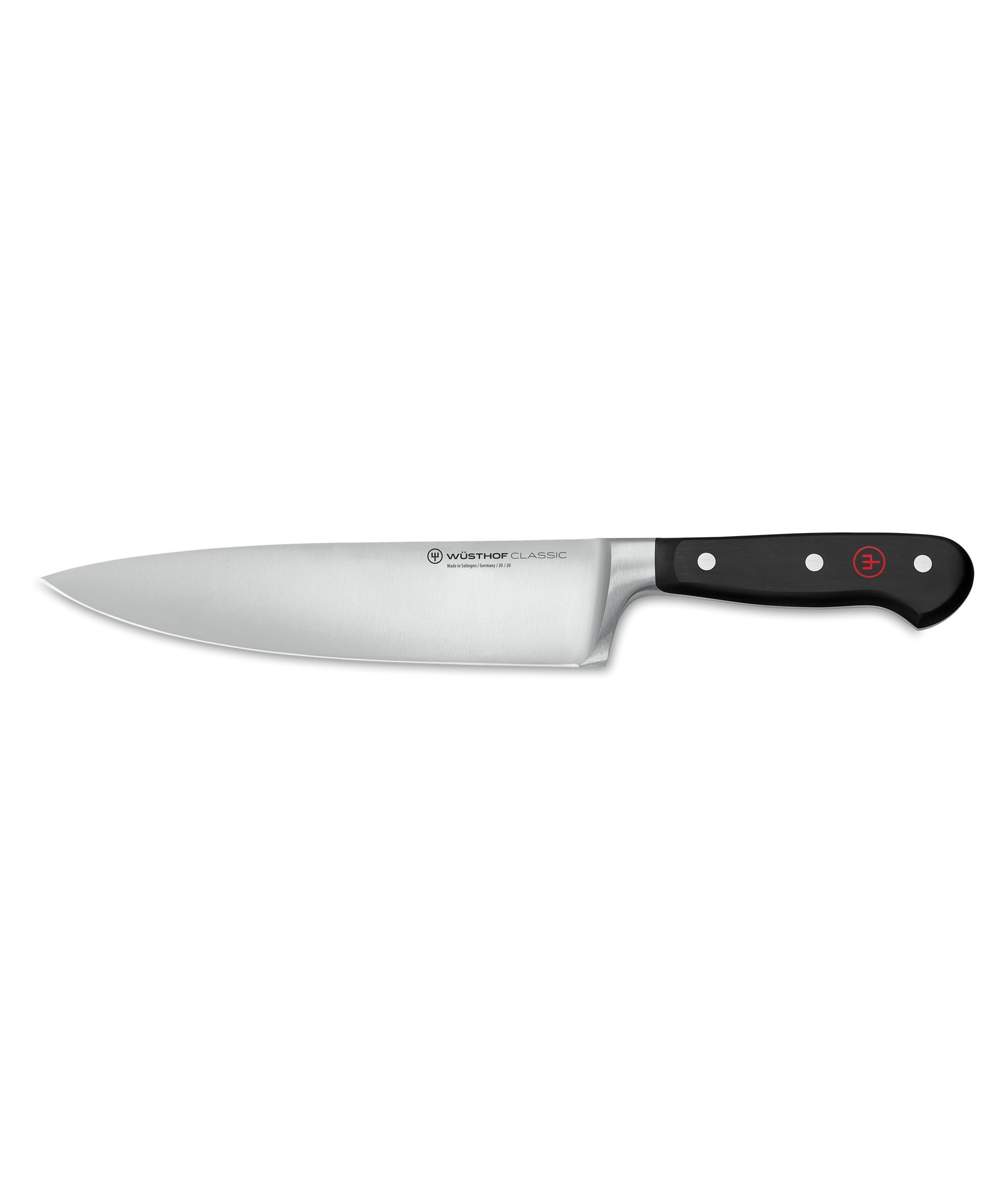
If you will cook for years and want to buy once, this is the step up. The Wüsthof Classic 8-inch (SKU 1040100120) is precision-forged high-carbon stainless, full tang, 58 HRC, made in Solingen, Germany — blade 8.0 by 1.9 inches, handle 4.5 inches.
Forged and full-tang means a denser, more balanced knife with a thicker profile that suits rock-chopping, and at 58 HRC it sharpens more easily than harder Japanese steel. Be honest, though: it costs several times the Victorinox, it is heavier, and a beginner will not unlock the difference on day one. You are paying for the knife it becomes over years — a good buy, not a necessary one.
Pros: Forged full-tang build; balanced rock-chop profile; 58 HRC balances edge life and toughness; made in Solingen, built for decades.
Cons: Premium price; heavier than the stamped picks; more knife than a beginner’s technique needs at first.
Best for: Beginners certain cooking is a long-term habit, who prefer to buy one knife for decades.
Upgrade mention: Shun Classic 8″ Chef’s Knife (DM0706)

Included so you know what the next level looks like. The Shun Classic pairs a hard VG-MAX core with a fine 16-degree edge per side, so it feels sharper out of the box than anything above — but it is more chip-prone on bone, frozen food, and twisting cuts. Learn on a forgiving knife first, then graduate to this. It gets a full treatment in our Wüsthof vs Shun comparison.
Pros: Exceptionally sharp, fine edge; light and precise.
Cons: Harder edge can chip with beginner technique; stricter care rules.
Best for: A second knife, once your grip, board, and care habits are settled.
FAQ
Do I need to spend a lot to get a good first chef’s knife?
No. The Victorinox and Mercer both cut and teach properly without a serious investment. Spend first on the knife, a honing rod, and a decent board — an expensive knife used badly on a glass board is worse than a cheap knife used well.
Honing vs sharpening — what is the difference?
Honing realigns an edge bent slightly by use; do it regularly. Sharpening removes metal to form a new edge; do it when honing stops working, or have it done professionally while you learn. A honing rod does not sharpen, whatever the packaging implies.
Can I put these knives in the dishwasher?
No — none of them. Heat, detergent, and rattling dull and damage edges and handles. Hand wash, dry straight away, store protected. It takes under a minute and doubles the life of the edge.
What size should a beginner start with?
An 8-inch chef’s knife, as with every pick here — long enough for melons and cabbages, short enough to control. Smaller knives force sawing motions that teach bad habits; larger knives are harder to control while you learn.
Verdict
Start with the Victorinox Fibrox Pro 8″ unless money is very tight — in which case start with the Mercer Culinary Millennia 8″ and do not feel short-changed. Buy the Wüsthof Classic 8″ only if you are buying for the long term on purpose. And leave the Shun Classic for your second knife, when your technique is ready for a harder, sharper edge.
Prices shown were confirmed by this site on Nov 2, 2026 — check the current price on Amazon before you buy.