
Best Stand Mixers for Home Bakers (2026)
Quick picks:
- Best overall: KitchenAid Artisan Series 5 (4.5-qt) — the default recommendation for a reason
- Best for serious baking: KitchenAid 6-Quart Bowl-Lift Stand Mixer (current 6-qt model) — bowl-lift power for stiff doughs
- Best value: Cuisinart Precision Master (5.5-qt) — near-KitchenAid performance for noticeably less money
- Best compact: KitchenAid Artisan Mini (3.5-qt) — full-size capability in a small-kitchen footprint
A stand mixer is the one kitchen appliance people tend to agonize over and then use for 20 years. Get the right one and it disappears into your routine — doughs, batters, meringues, whipped cream, all easier and better. Get the wrong one and it’s a heavy reminder on your countertop that you cheaped out on the thing you use every week.
For home baking — cakes, cookies, bread dough, pizza dough, the occasional batch of cinnamon rolls — you don’t need a commercial machine. You need enough power to knead a real dough without the mixer walking off the counter, a bowl big enough for a double batch, and attachments that actually fit and work.
Tilt-head vs. bowl-lift: the real difference
Tilt-head mixers have a hinged head that tilts back so you can add ingredients and swap the bowl. They’re shorter, lighter, and easier to live with — this is the design most home bakers want.
Bowl-lift mixers keep the head fixed; the bowl cranks up into position on arms. The head doesn’t move, which makes the whole machine stiffer and more powerful — at the cost of a taller, heavier body that’s harder to slide under cabinets. Bowl-lift is the design of choice for dense bread dough and large batches.
The honest version: tilt-head handles everything up to stiff bread dough in normal batch sizes. If you’re regularly making 4+ loaves at once or working very stiff doughs (bagels, low-hydration breads), bowl-lift earns its keep. For everyone else, tilt-head is the better daily experience.
The picks
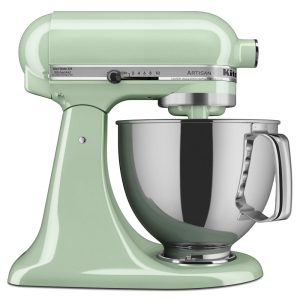
Best overall: KitchenAid Artisan Series 5 (4.5-qt, KSM150PS)
$379.99
The Artisan is the mixer every other mixer gets compared to, and it’s still the right default for most home bakers. The 4.5-quart stainless bowl handles a double batch of cookie dough or a single standard bread recipe comfortably, the all-metal gears hold up under real use, and the tilt-head design makes ingredient additions and bowl swaps painless.
What really separates KitchenAid is the attachment ecosystem: the pasta roller, meat grinder, grain mill, and spiralizer attachments turn the mixer into a platform. A dozen attachments fit the Artisan’s power hub, and most are genuinely useful rather than gimmicks. No other brand comes close here.
Pros: Deep attachment ecosystem; proven durability (these routinely last 15+ years); excellent bowl/beater fit for thorough mixing; huge color selection.
Cons: Priciest tilt-head on this list at full retail; the Artisan can struggle with very stiff doughs (that’s what the 6-qt bowl-lift is for); heavy at ~23 lbs.
Best for: The home baker who wants the safe, proven choice that does everything well and can grow into a multi-purpose machine.
Best for serious baking: KitchenAid 6-Quart Bowl-Lift Stand Mixer (current 6-qt model)
$529
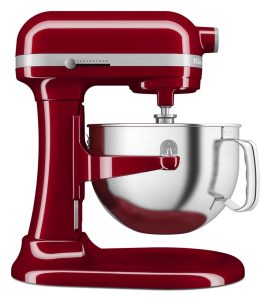
When the doughs get stiff and the batches get big, a bowl-lift design is the answer. The fixed head and crank-up bowl handle bagel dough, stiff rye, and quadruple batches without complaint — jobs where a tilt-head mixer starts to strain and bounce. The 6-quart bowl swallows enough dough for 4+ loaves or a full holiday cookie run.
The trade-offs are real: it’s heavy, it’s tall enough to be an issue under low cabinets, and bowl-lift machines are slightly more fiddly for adding ingredients mid-mix (the bowl cranks down rather than the head lifting away). This is a machine for people who bake a lot, not a machine for people who might bake.
Pros: Serious power for stiff doughs; 6-qt capacity for large batches; all-metal construction; bowl-lift stability under load.
Cons: Heavy and tall; more expensive; overkill if you bake once a week; bowl-lift access is less convenient than tilt-head.
Best for: Bread bakers, batch bakers, and anyone who regularly pushes a tilt-head mixer past its comfort zone.
Best value: Cuisinart Precision Master (5.5-qt, SM-50)
$274
Cuisinart’s play here is simple: give you more capacity and comparable performance for roughly half of the KitchenAid Artisan’s street price. And for most baking tasks, it works — the 500-watt motor handles cookie dough and cake batter fine, the 5.5-quart bowl is genui
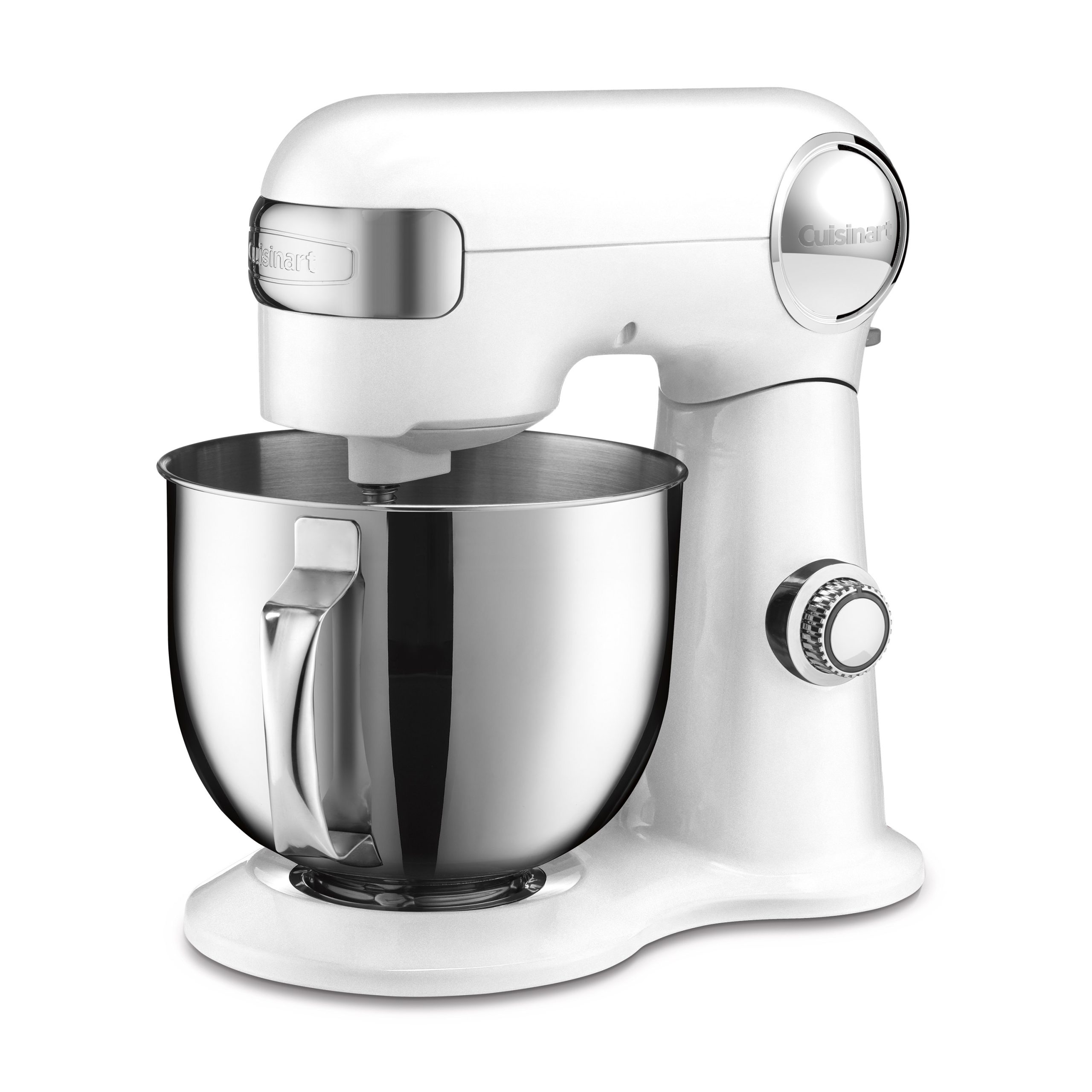
nely generous, and it ships with the standard trio of attachments (flat beater, dough hook, wire whip) plus a splash guard.
The honest caveats: the attachment ecosystem is a fraction of KitchenAid’s, long-term durability track record isn’t in the same league, and fit-and-finish feels a step down. But if the question is “does it mix and knead well at a reasonable price,” the answer is yes — this is the value pick without an asterisk.
Pros: Excellent price for a 5.5-qt machine; solid mixing performance; includes splash guard; lighter than the KitchenAids.
Cons: Small attachment ecosystem; durability unproven next to KitchenAid’s decades; resale value is poor if you ever upgrade.
Best for: The budget-conscious baker who wants capacity and performance now and isn’t building an attachment collection.
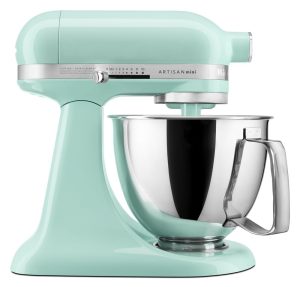
Best compact: KitchenAid Artisan Mini (3.5-qt)
$449.95
The Mini is 20% smaller than the standard Artisan but keeps the same power and attachment compatibility — it runs the full KitchenAid attachment lineup. For small kitchens, apartment counters, or bakers who never double a batch, it’s the same mixer in a friendlier package: same gears, same build, same tilt-head convenience.
The one real limitation is capacity. The 3.5-quart bowl is fine for standard single recipes but tops out around one standard bread loaf’s worth of dough or 5 dozen cookies. If you batch-bake, this isn’t your machine. If you bake for one or two and hate countertop clutter, it’s arguably the best choice on this list.
Pros: Full-size power and attachments in a compact body; same proven KitchenAid durability; great for small kitchens.
Cons: 3.5-qt bowl limits batch sizes; price per quart is the worst on this list.
Best for: Small kitchens, single/double-person households, and bakers who value counter space over batch size.
FAQ
Tilt-head or bowl-lift for bread dough?
Normal bread dough — standard hydration, one to two loaves — is fine on a tilt-head Artisan. If you regularly make stiff, low-hydration doughs (bagels, pretzels) or bake in bulk, the 6-qt bowl-lift’s design is noticeably better under load.
Is KitchenAid really worth the premium over Cuisinart?
For the machine itself, the gap is smaller than KitchenAid fans admit. For the attachment ecosystem and 15-year track record, KitchenAid is in a different league. If you’ll ever buy attachments, KitchenAid pays back. If you just need a mixer, the Cuisinart is a fair deal.
How much bowl capacity do I actually need?
A 4.5-quart bowl covers a double batch of cookies, one standard bread recipe, or a 9-inch layer cake batter with headroom. Go bigger (5.5–6 qt) if you batch-bake or make pizza dough for a crowd. Go smaller only if counter space forces it.
Do stand mixers really last decades?
The KitchenAids genuinely can — all-metal gears, simple motors, replaceable parts. The main failure point across brands is cheap nylon gears in budget machines; every pick on this list has metal gearing. Cuisinart’s long-term record is shorter but respectable so far.
Verdict
Buy the KitchenAid Artisan Series 5 — it’s the default for a reason, with the attachment ecosystem to back it up. Buy the KitchenAid 6-Quart Bowl-Lift if you’re a bread baker or batch baker who needs the bowl-lift muscle. Buy the Cuisinart Precision Master if you want 90% of the mixing for about half the money. And if counter space is the constraint, the Artisan Mini loses nothing but capacity.
Prices shown are typical street prices and may have changed — check the current price on Amazon.