Quick picks:
- Buy the Wüsthof Classic 8″ if: you rock-chop, want a tougher edge that forgives rough use, and prefer easier maintenance
- Buy the Shun Classic 8″ (DM0706) if: you push-cut, want the sharpest edge out of the box, and will follow stricter care rules
- The short answer: Same job, opposite philosophies — German toughness and weight vs Japanese hardness and finesse
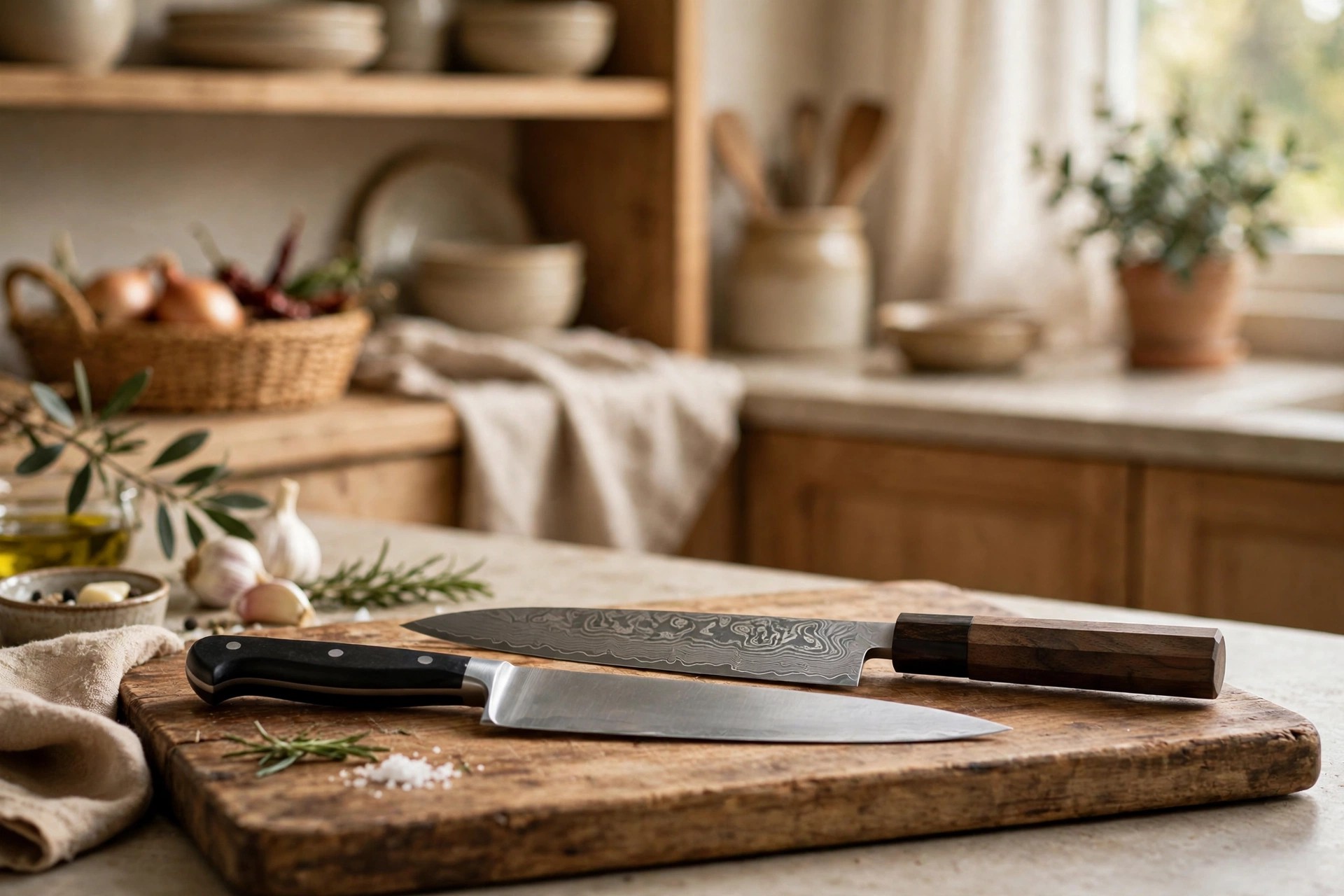
German vs Japanese is the oldest argument in kitchen knives, and the Wüsthof Classic 8-inch and Shun Classic 8-inch are the cleanest way to see it. Both are flagship 8-inch chef’s knives. Almost everything else — steel, edge angle, shape, handle, care — is different on purpose. Neither philosophy is better in the abstract; one is better for how you cut, what you cut, and how much care you will honestly give a knife.
At the prices confirmed on Nov 2, 2026, the Shun Classic 8″ at $140.14 is $29.86 cheaper than the Wüsthof Classic 8″ at $170.00 — so price alone does not make the German knife the cheaper choice here.
Head to head
| Wüsthof Classic 8″ | Shun Classic 8″ (DM0706) | |
|---|---|---|
| Price | $170.00 | $140.14 |
| Origin / build | Precision-forged, full tang, Solingen, Germany | Handcrafted in Japan; VG-MAX core with Damascus cladding |
| Hardness | 58 HRC | Harder VG-MAX core — more chip-prone |
| Edge | Wider angle, tougher edge; rock-chop geometry | 16° per side; finer, sharper edge |
| Profile | Thicker, heavier, more curved belly | Thinner, lighter at ~7.1 oz, flatter precision profile |
| Handle | Western handle, 4.5″ | D-shaped Pakkawood handle |
| Care | Hand wash; tolerates normal home use better | Hand wash; no bone, no frozen food; soft wood board |
The two philosophies, plainly explained
German (Wüsthof): Tougher steel at 58 HRC, a thicker blade, and a curved belly made to rock over herbs and onions, with an edge ground at a wider, more durable angle. It dulls sooner than a hard Japanese edge, but resists chipping, sharpens easily, and tolerates a busy kitchen’s small abuses.
Japanese (Shun): A hard core — Shun’s proprietary VG-MAX — clad in softer stainless Damascus: 34 layers per side, 68 total, plus the core making 69 layers. That core holds a much finer edge, ground to 16 degrees per side, and slices cleaner on fish, vegetables, and boneless proteins. The trade is brittleness: a hard, thin edge chips instead of bending on bone, frozen food, or a twisting cut.
The picks, in detail
Wüsthof Classic 8″ Chef’s Knife
Price: $170.00
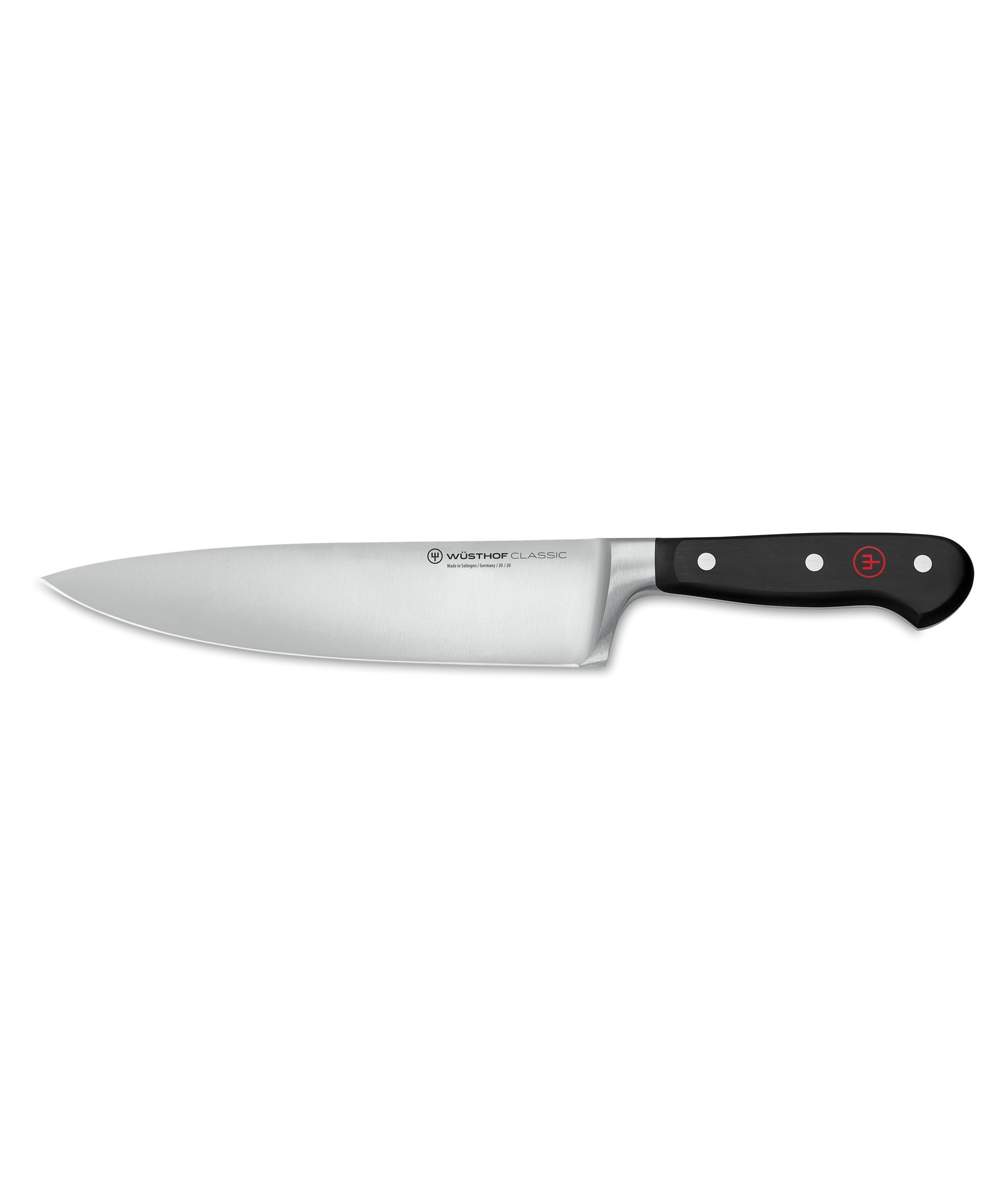
The Wüsthof Classic (SKU 1040100120) is precision-forged from one piece of high-carbon stainless, full tang, made in Solingen, Germany — blade 8.0 by 1.9 inches, handle 4.5 inches. In hand it is the denser, more substantial knife here, with a classic Western balance and belly.
That shape is its argument. If your default motion is rocking through herbs or an onion, the Wüsthof’s curve works with you. Its 58 HRC edge is also the practical choice for a mixed diet — work near chicken bones, winter squash, jobs a thinner edge should not do. Its limits mirror the Shun’s strengths: it never feels as effortlessly sharp, thick produce can wedge where a thinner blade glides, and its weight can tire you over a long session.
Pros: Tough 58 HRC edge that resists chipping; forged full-tang build and confident weight; ideal rock-chop geometry; easiest to maintain and sharpen of the two.
Cons: Less fine edge than the Shun; thicker blade can wedge in dense produce; heavier in long sessions.
Best for: Rock-choppers, mixed-diet home cooks, and anyone who wants one durable main knife with forgiving care rules.
Shun Classic 8″ Chef’s Knife (DM0706)
Price: $140.14

The Shun Classic 8-inch (DM0706) is handcrafted in Japan around a VG-MAX core clad in 34 layers of stainless Damascus per side. At roughly 7.1 ounces it is the lighter knife, and its D-shaped Pakkawood handle is shaped for a pinch grip.
The first cut tells you what you paid for. A 16-degree edge per side moves through onions, tomatoes, and raw fish with noticeably less resistance than the Wüsthof, and keeps that fine edge longer in normal slicing use. For push-cutting and draw-cutting, it is the better tool — and it is not particularly close.
The care contract is stricter, and it is the maker’s own guidance, not fussiness: no bone, no frozen food, hand wash only, soft wood or quality synthetic board. Twist the blade to pry a squash apart, and a hard thin edge can chip. Prevention is the deal you make for that sharpness.
One buying warning: buy the standard black-handle DM0706. Do not confuse it with the Shun Classic Blonde 8-inch (DM0706W) — a different model with a different listing.
Pros: Sharpest edge here, and it holds it; thin, light ~7.1 oz profile for precise slicing; Damascus cladding that also helps food release; ideal for push-cutting.
Cons: Hard edge can chip on bone, frozen food, or twisting cuts; stricter board and care rules; D-shaped handle suits pinch-grip users best.
Best for: Push-cutters, vegetable- and fish-heavy cooking, and cooks who will happily follow the care rules for a finer edge.
Cutting style decides it
Rock through herbs, mince by rocking, and work through mixed family meals without thinking about the knife: Wüsthof. Slice precisely, prep a lot of vegetables and boneless protein, and enjoy a knife that feels sharp every time: Shun.
If you are still learning, be honest about your habits, not your ambitions. A cook who will use any board and cut whatever is in front of them will be happier — and spend less on repairs — with the Wüsthof. The Shun rewards careful habits. New to chef’s knives? Start with our Best Chef’s Knife for Beginners (2026).
FAQ
Which knife stays sharp longer?
The Shun, in normal slicing use — its harder core holds a finer edge longer, assuming its care rules are followed. One chip from bone or frozen food undoes months of that advantage, which is why the tougher Wüsthof edge often looks better after a year in a rough-and-ready kitchen.
Can I sharpen both knives the same way?
Not quite. The Wüsthof responds well to a honing rod and is straightforward to sharpen. The Shun should be kept at its 16-degree angle, ideally on whetstones or by a sharpener experienced with Japanese knives — a grooved honing rod can be too aggressive for its hard edge, so use a fine ceramic rod or a stone, following Kai’s guidance.
Which is better for a whole chicken or hard squash?
The Wüsthof, clearly. Its tougher 58 HRC edge and thicker profile tolerate work around joints and through hard squash far better. Neither knife is a cleaver or a boning knife, but between these two, only the Wüsthof should be near that work. Keep the Shun away from bone entirely.
Is the Damascus pattern on the Shun just decoration?
Mostly visual, with a small practical side: the cladding protects the hard core and can help food release slightly. The sharpness comes from the VG-MAX core and 16-degree edge, not the pattern. Buy it for the edge; enjoy the pattern.
Verdict
Buy the Wüsthof Classic 8″ if you want the durable, forgiving, rock-chopping workhorse — it is the safer single-knife choice for most home kitchens. Buy the Shun Classic 8″ (DM0706) if sharpness and precision are the point and your habits can protect a harder edge. German vs Japanese is not a quality ranking. It is a matching exercise, and the right answer is the knife whose rules you will actually live by.
Prices shown were confirmed by this site on Nov 2, 2026 — check the current price on Amazon before you buy.