
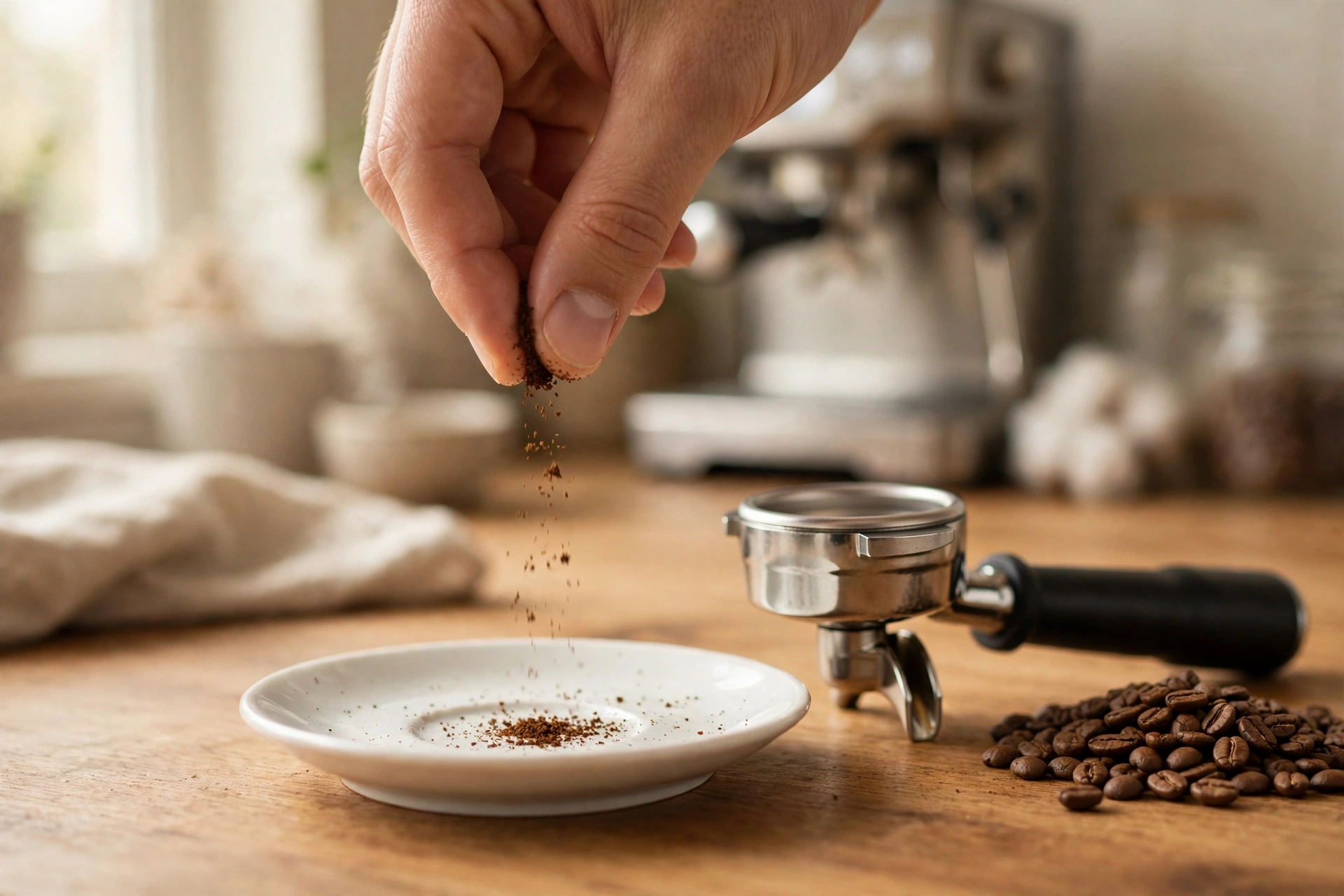
Every espresso recipe says “grind fine.” Almost none tell you what fine looks like, feels like, or does in the cup — so beginners pull a shot that chokes or gushes, with no reference for what to change next.
“Fine” is not a single setting you can copy. It’s a range, and where you land depends on your beans, dose, basket, and machine. Once you understand what grind controls, the word stops being vague.
What grind size controls
Grinding breaks a bean into thousands of particles. Smaller particles expose more surface area, so water extracts flavor faster. Grind also controls resistance: finer grounds pack tighter in the puck and slow the shot, coarser grounds leave more space and let water run faster.
That gives you two effects from one change:
- Finer = slower flow + faster extraction
- Coarser = faster flow + slower extraction
When a shot tastes sour and thin and ran in 15 seconds, it is usually both under-extracted and too fast. When a shot tastes bitter and harsh and took 50 seconds, it is usually over-extracted and too slow. Grind is the first dial to reach for in both cases, because it moves both problems at once. For the full framework — dose, yield, and time together — see how to dial in espresso.
What espresso-fine actually looks and feels like
Forget micron numbers — you cannot measure them at home, and grinder numbers do not transfer: a “12” on one grinder means nothing on another. Use touch and sight instead:
- Too coarse for espresso: particles feel like coarse sand or raw sugar. You can clearly see separate gritty grains, and they do not clump at all when you pinch them.
- In the espresso range: the grounds feel like fine sand or table salt, slightly softer. Pinched between your fingers, they hold together faintly and leave a light dusting on your skin. Small, soft clumps are normal.
- Too fine: the grounds feel like flour or powdered sugar. They clump hard, smear instead of sprinkling, and pack down with almost no pressure. At this end the machine often struggles to push water through at all.
A useful comparison: drip coffee grind looks like coarse sand. Espresso grind is noticeably finer than that — but it is not powder. If your grounds look like cocoa powder, you have almost certainly gone too far for most home machines and baskets.
Why the same setting never works for every bean
You dial in one bag perfectly, open a new bag at the exact same setting — and the shot is wrong. That is normal, for three reasons:
- Roast level changes density. Darker roasts are more brittle and break into finer particles more easily. They usually need a slightly coarser setting than a light roast at the same dose.
- Beans age. Fresh beans contain gas that adds resistance in the puck. As beans rest over one to three weeks, shots tend to run faster at the same setting, so you gradually grind a little finer.
- Every grinder is different. Burr wear, alignment, and design mean settings do not transfer between grinders, and often not even between two units of the same model.
So do not chase a number someone posted online. Chase a result in your cup and a time range in your kitchen.
Use time as your feedback, not as a rule
For a typical double shot, start by aiming for roughly 25 to 35 seconds for a yield about twice the dose — for example, 18 grams in and about 36 grams out. That is a starting window, not a law. What matters is the pattern:
- Under 20 seconds, sour, thin, salty: go finer, one small step at a time.
- 25–35 seconds, balanced sweetness, syrupy body: you are in range — change nothing and taste again tomorrow before adjusting.
- Over 40 seconds, bitter, drying, ashy: go coarser, one small step at a time.
- Machine chokes, only drips, or nothing comes out: go noticeably coarser, purge the old grounds from the chute, and try again. Do not force repeated choked shots.
- Gushing from the start, spluttering, pale quickly: go noticeably finer, and also check your distribution — an uneven puck can gush even at the right grind.
If you are learning to tell those flavors apart, sour vs bitter espresso walks through the diagnosis shot by shot.
How to adjust without wasting a whole bag
- Fix everything else first. Keep dose, yield target, tamping, and beans the same while you adjust grind. If you change two things, you learn nothing.
- Move one small step. On a stepped grinder, one notch. On a stepless grinder, a tiny turn — smaller than you think you need.
- Purge a little. Grinders hold onto old grounds in the chute and burr chamber. After changing the setting, grind and discard a small amount so the next dose is actually at the new size.
- Pull, weigh, time, and taste. Write it down if you need to: setting, time, yield, one word for taste. Three shots of notes will teach you more than thirty shots from memory.
- Repeat only if needed. If the shot moved in the right direction but not far enough, take another small step the same way.
Note: pressurized (dual-wall) baskets create their own resistance, so they are far more forgiving of grind — one reason they help beginners.
The mistakes that look like grind problems
Not every bad shot is a grind problem, and grinding finer will not fix these:
- Uneven distribution or tamping: water finds one weak path through the puck and races through it, leaving the rest under-extracted. The shot is fast and sour even at a fine grind.
- Old or stale beans: they run fast, produce thin crema, and taste flat no matter how fine you go. Going finer only makes them bitter as well as flat.
- A dirty machine: old oils and scale mimic a bad grind setting. Clean first, then dial in again.
- Inconsistent dose: weighing 17 grams one morning and 19 the next changes resistance as much as a grind step does. Weigh every time while you are learning.
Rule these out before you make a big grind move. Otherwise you will dial in around a problem that comes straight back tomorrow.
A simple starting routine for a new bag
Open the bag, set the grinder to the finer end of its espresso range — fine sand, faintly clumping, not flour — and pull a weighed shot. Too fast and sour: one step finer. Too slow and bitter: one step coarser. Two or three shots should put you in the balanced window.
Then leave it alone. There is no perfect permanent setting. Your job is to recognise, by feel, time, and taste, when you are inside the range that works, and nudge back in when a new or older bag pushes you out.
The bottom line
“Fine” means fine sand, not powder: particles that pinch together faintly, resist water enough for a 25-to-35-second shot, and extract sweetness before bitterness. Numbers do not transfer between grinders or beans, so judge by touch, time, and taste. Change one small step at a time, purge the old grounds, and keep everything else fixed while you learn. Do that, and grind size stops being the mystery variable in your espresso — it becomes the most reliable tool you have.