
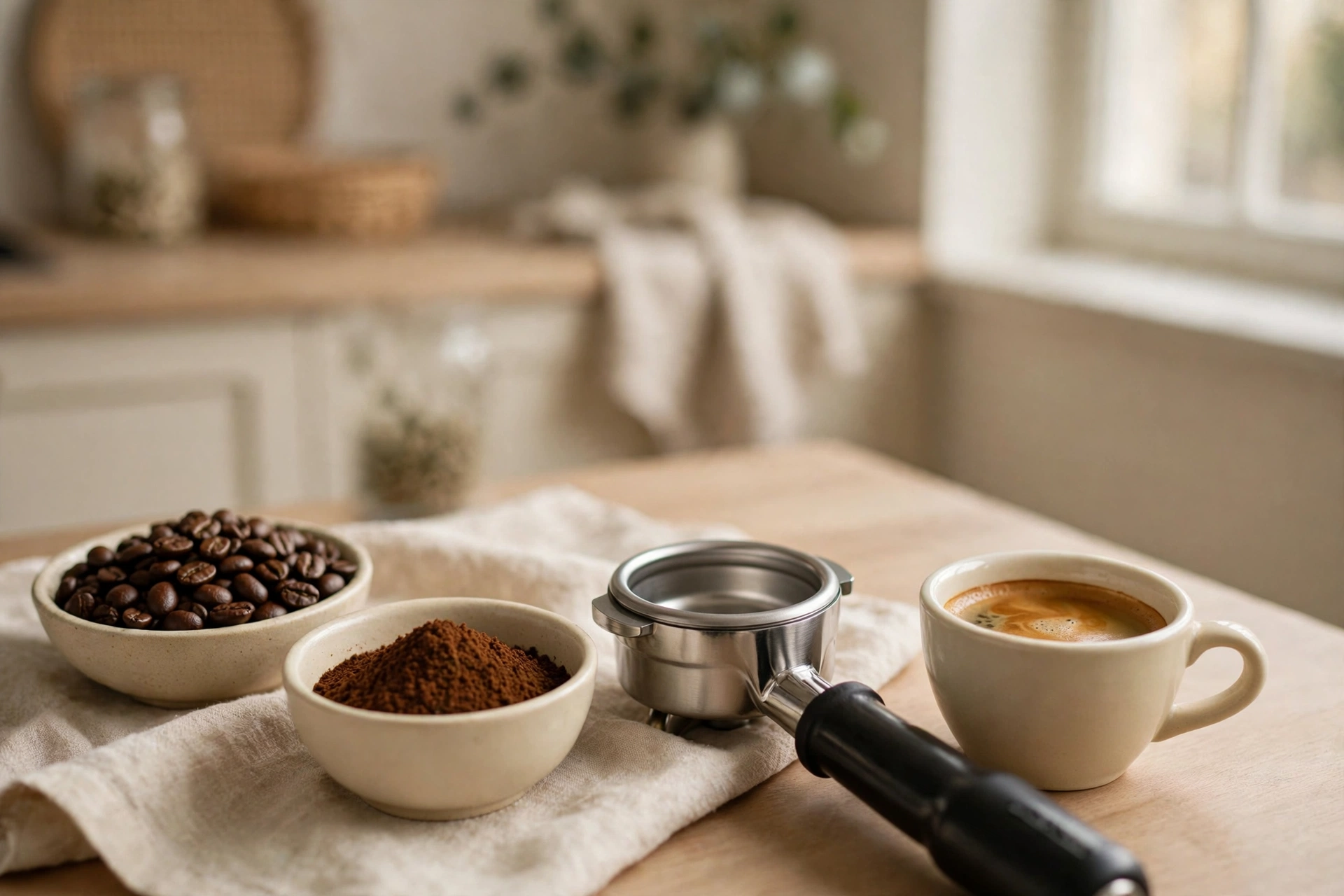
If you are new to home espresso, pre-ground coffee feels like the sensible shortcut. No grinder to buy, no settings to learn — just scoop, tamp, and pull. Whole beans feel like the serious option, but they come with extra cost and extra work.
The honest difference is not snobbery. It comes down to two things pre-ground cannot give you: freshness after the first few days, and control over grind size. Whether those two things matter enough to change what you buy depends on your machine, your basket, and how you actually drink espresso.
Why coffee goes stale faster once it is ground
A whole bean is a surprisingly good storage container. Most of its aromatic compounds are locked inside, protected from oxygen. Grinding breaks that container into thousands of tiny pieces and exposes almost all of that surface at once.
From that moment, two things happen:
- Aroma escapes. The volatile compounds that make espresso smell sweet and complex are the first to fade.
- Oxidation speeds up. Oxygen reaches far more of the coffee, far faster, and the flavor flattens.
Whole beans also lose flavor over weeks. Ground coffee loses a noticeable amount in days, and the finest, most delicate notes in hours. That is why a bag of pre-ground can taste fine on day one and dull, flat, and slightly cardboard-like a week later — even if you sealed the bag carefully. Sealing slows the process. It does not reverse it.
For drip coffee, that loss is noticeable. For espresso, it is amplified. Espresso uses a small dose, high pressure, and a short extraction, so there is nowhere for stale flavor to hide.
The bigger problem: you cannot change the grind
Freshness gets most of the attention, but for espresso, grind control is usually the deciding factor.
Espresso only works in a narrow grind window. A little too coarse and the shot gushes in 15 seconds, sour and thin. A little too fine and it chokes or drips for 50 seconds, bitter and drying. As we covered in espresso grind size: what “fine” actually means, that window moves — with the bean, the roast, the age of the coffee, and even the humidity.
Pre-ground coffee locks you to one grind that someone else chose, on a different grinder, for a different machine. Labels like “espresso grind” or “fine grind” are not a standard. One roaster’s espresso grind can be noticeably coarser than another’s, and neither was set for your basket and dose.
With whole beans and your own grinder, when a shot runs fast you go one step finer. When it runs slow, you go one step coarser. That small adjustment is the whole process of how to dial in espresso. With pre-ground, you can change dose a little or tamp differently, but those are weak substitutes. You are trying to steer with everything except the main control.
That is also why pre-ground gets harder to use as it ages. Older beans offer less resistance in the puck, so shots tend to run faster over time. With whole beans you compensate by grinding finer. With pre-ground, the shots just keep getting faster.
When pre-ground actually can work
Pre-ground is not unusable. In the right setup, it can make a decent, consistent drink — especially milky drinks where espresso is not standing alone.
Pressurized baskets are the exception. A pressurized, or dual-wall, basket creates its own resistance with a tiny exit hole, instead of relying entirely on the coffee puck. That makes it far more forgiving of grind size and freshness. If your machine came with a pressurized basket and you are learning the basics, pre-ground made specifically for espresso is a reasonable starting point. We explain why that basket behaves differently in pressurized vs non-pressurized portafilter baskets, explained.
Pre-ground also makes sense if:
- You do not own a grinder yet and want to learn your machine first, one variable at a time, before buying more gear.
- You mainly make lattes and cappuccinos, where steamed milk softens small flaws in the shot.
- You use it fast. A small bag used within a few days of opening will always beat a large bag kept for a month.
- Convenience decides whether you make coffee at all. A simple routine you use daily is better than a perfect setup you avoid on busy mornings.
What pre-ground will struggle with is a non-pressurized basket, straight espresso or long blacks where you taste everything, and light roasts that already need precise extraction to taste sweet instead of sharp.
What changes when you switch to whole bean
Switching does not automatically make great espresso. It gives you the tools to get there.
You will notice three practical changes:
- Better aroma and sweetness, especially in the first two weeks after roasting. Freshly ground coffee right before you pull the shot keeps flavors that pre-ground lost in the bag.
- Thicker, more stable crema and more body — not because crema equals quality, but because fresher coffee still holds the gases and compounds that stale coffee has lost.
- A learning curve. You now own the most important variable. Your first bag will include a few fast, sour shots and a few slow, bitter ones while you find the range. That is not failure. That is dialing in, and it gets much faster after the first bag.
You do not need to grind for every brewing method with laboratory precision. For espresso, you do need a grinder that can make small, repeatable adjustments in the fine range. A grinder that is fine for drip or French press is not always fine enough — or adjustable enough — for espresso.
If you buy pre-ground, do it this way
If pre-ground is the right call for you right now, a few habits close much of the gap:
- Buy small amounts, more often. Choose the smallest bag you will finish within about a week of opening.
- Buy ground-for-espresso from a roaster, not generic “fine.” And if a roaster asks about your machine or basket, tell them — they may grind differently for pressurized baskets.
- Check the roast date, not just a best-before date. Fresher at purchase gives you a longer usable window at home.
- Store it airtight, cool, and dark. Squeeze air from the bag, seal it tightly, and keep it away from heat and steam. Do not store it in the fridge, where moisture and odors work against you.
- Use the pressurized basket if you have one, and do not judge your machine’s ceiling by those results alone.
If you buy whole bean, do it this way
- Buy whole beans with a roast date and aim to use them in their sweet spot: generally after a few days of rest after roasting, and within a few weeks — follow the roaster’s guidance for that coffee.
- Grind only what you need, right before you pull the shot. Pre-grinding a week’s worth the night before recreates the pre-ground problem at home.
- Weigh your dose. Consistency in dose makes your grind adjustments meaningful.
- Freeze only in portions, if you freeze at all. If you buy more than you will use in a few weeks, freezing single portions in airtight bags can help, but daily opening and closing of one large frozen bag invites moisture. For most beginners, buying smaller and more often is simpler.
The bottom line
For espresso, whole bean wins on the two things that matter most: freshness and grind control. Pre-ground loses aroma quickly and leaves you unable to make the one adjustment that fixes most bad shots.
That does not make pre-ground a mistake. In a pressurized basket, in milky drinks, and in a small bag used quickly, it is a practical starting point — especially while you are learning your machine or deciding whether home espresso is for you.
Think of it as a sequence, not a verdict. Start where your budget and routine allow. When your shots taste flat no matter what you change, or they run fast and you have no way to slow them down, you have found the limit of pre-ground. That is the moment a grinder and a bag of whole beans stop being an upgrade and start being the answer.