
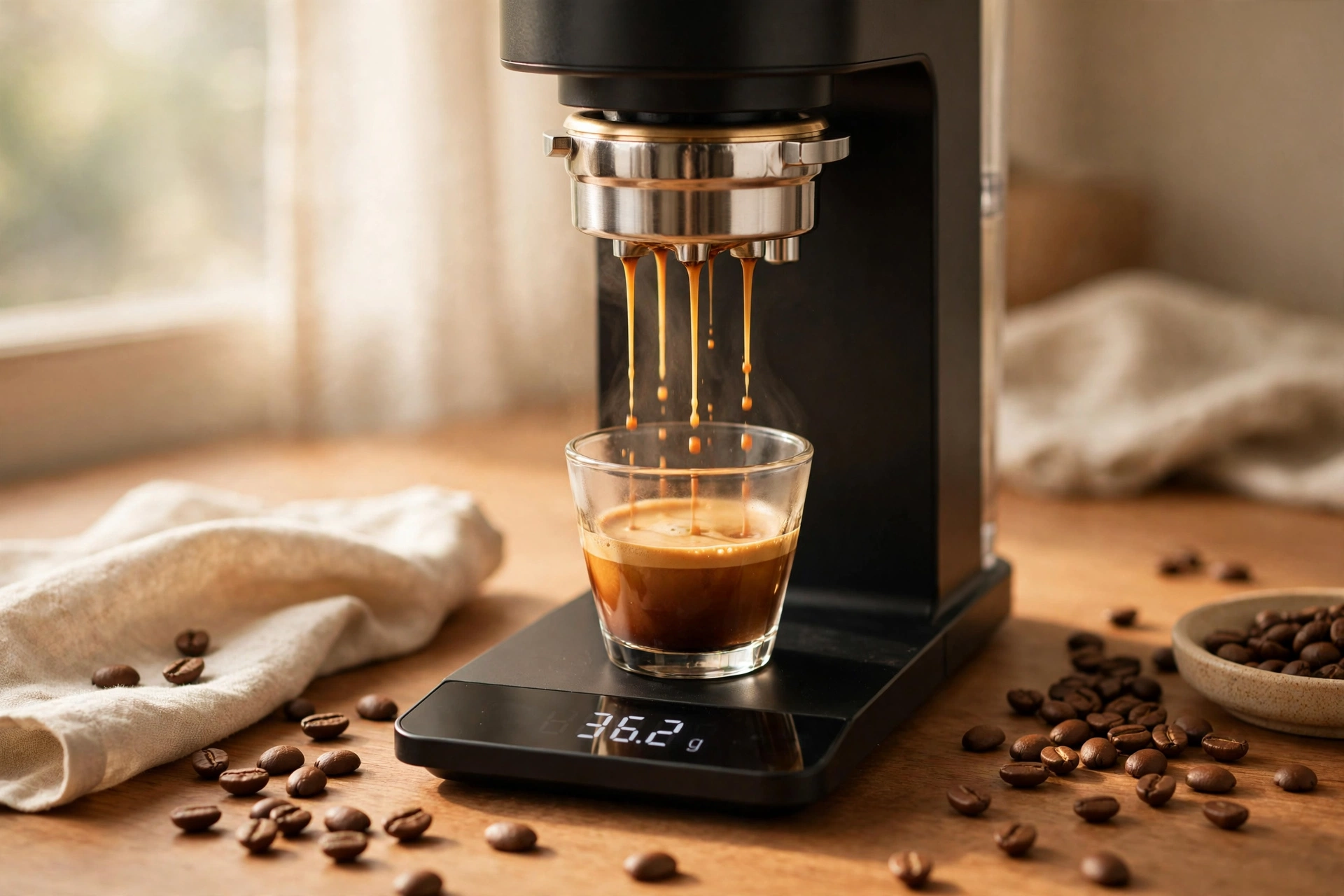
Every bag of coffee is different, which means your espresso setup can’t be “set and forget.” Dialing in is the process of adjusting three variables — dose, grind size, and yield — until a new bag of beans tastes the way it should. It sounds technical. In practice, it’s about six minutes of paying attention, and it’s the single highest-leverage skill in home espresso. A dialed-in $300 setup beats an undialed $1,500 setup every time.
One assumption: dialing in only works on a machine that can pull a real shot with a non-pressurized basket. If yours can’t, that’s a gear problem, not a technique problem.
Dose: your anchor
Dose is the weight of dry coffee in the portafilter, measured in grams. The standard double is 18 grams, and most double baskets are rated for 18–20g (smaller ones for 14–16g).
Here’s the rule that makes everything else easier: pick a dose and lock it. Dose is your anchor — the one variable you don’t touch while learning. Match it to your basket (don’t cram 20g into an 18g basket; without proper headspace the puck presses against the shower screen and extracts unevenly), then leave it alone.
What dose changes in the cup: more coffee means more resistance, so the shot runs slower with heavier body. But because it also changes headspace and puck dynamics, adjusting dose to fix a bad shot usually creates two new problems. Change grind instead. Adjust dose only when the basket demands it.
Grind size: the main lever
Grind size is the variable you actually move. Finer grounds expose more surface area to water, so extraction increases and flow slows down. Coarser grounds do the opposite.
How to adjust it: move in small steps — one notch at a time on a stepped grinder, tiny movements on a stepless one. After every adjustment, purge 1–2 grams through the grinder. Grinders retain old grounds, and without purging you’re tasting yesterday’s setting.
What grind changes in the cup:
- Too fine: the shot chokes or drips, runs long, tastes bitter, dry, ashy.
- Too coarse: the shot gushes, runs fast, tastes sour, salty, thin, watery.
- Just right: balanced sweetness, syrupy body, no harsh edges.
If you remember one sentence from this article, make it this one: grind finer when it’s sour, coarser when it’s bitter. That single rule fixes the majority of bad shots.
Yield: the ratio
Yield is the weight of liquid espresso in the cup. Baristas talk about it as a brew ratio — dose to yield. The modern starting point is 1:2: 18 grams in, 36 grams out. That 1:2 shot is sometimes called a “normale.”
Shorter and longer ratios have names and personalities:
- Ristretto (1:1 to 1:1.5): syrupy, intense, sweeter, less extracted.
- Normale (1:2): the balanced default.
- Lungo (1:3 to 1:4): thinner body, more extracted, more bitterness risk.
How to adjust it: put a scale under your cup and stop the shot at your target weight. Yield is your fine-tuning dial once grind is close — nudge it up 2–4 grams to sweeten and extract a little more, or pull it back to intensify.
One thing to unlearn: shot time is an output, not a target. The old “25–30 seconds” rule is a sanity check, not gospel. If a 22-second shot tastes great and a 30-second shot tastes harsh, the 22-second shot wins. Time tells you whether you’re in a reasonable neighborhood; taste tells you whether to stay.
The workflow: dialing in a new bag of beans
- Check the roast date. The sweet spot for espresso is roughly 5–14 days off roast. Very fresh beans (under 4 days) are full of CO2 — shots run fast and taste sharp. Let them rest. Old beans (past 4–5 weeks) run fast and taste flat; you can grind finer to compensate, but only so far.
- Lock your dose. 18 grams, or whatever your basket is rated for. Weigh every dose.
- Set your target yield. Start at 1:2 — 36 grams out for an 18-gram dose.
- Pull the shot. Start your timer when the pump starts. Note the time and, more importantly, taste the shot.
- Adjust one variable — grind:
- Sour, salty, thin, sharp, or fast (well under 20 seconds) → grind finer.
- Bitter, dry, ashy, harsh, or choked/slow (well over 35 seconds) → grind coarser.
- Close but not quite there? Nudge the yield instead: a few grams more to sweeten, a few less to intensify.
- Repeat. Most bags dial in within 2–4 shots. When it clicks, write down the recipe — dose, yield, time, and grinder setting. Grinders drift between cleanings and memories are unreliable.
Change one variable at a time. If you move grind and dose together, you’ll never know which one fixed it, and you’ll be re-learning the same lesson next week.
Quick troubleshooting
- Sour and fast → under-extracted. Grind finer.
- Bitter and slow → over-extracted. Grind coarser.
- Sour AND bitter at the same time → channeling. Water is punching through cracks in the puck instead of flowing evenly, so part of the coffee over-extracts while the rest under-extracts. Fix your distribution: stir the grounds to break up clumps (a simple WDT tool or even a toothpick works), then tamp level. Don’t tamp harder — tamp straighter.
- Wildly inconsistent shot to shot → you’re probably not purging after grind changes, or your dose is varying. Weigh the dose, purge the grinder, keep everything else identical.
FAQ
Do I really need a scale?
Yes. A 0.1-gram scale is the single most important espresso accessory, and it’s not close. You cannot dial in what you can’t measure — dose and yield both need weighing. Eyeballing volume is how you spend a month wondering why Tuesday’s shots were better.
How often do I need to re-dial?
Every new bag — different bean, different roast, different recipe. Within the same bag, your recipe usually holds; as beans age over a couple of weeks you might need to grind a touch finer as they degas and become less resistant. Small tweaks, not a full re-dial.
What if my grinder can’t grind fine enough?
This is common with grinders not built for espresso — either the adjustment steps are too big or the burrs physically can’t reach espresso range. The symptom is unmistakable: you’re at the finest setting and shots still run fast and sour. When the grinder is maxed out, the grinder is the ceiling, and no technique gets around it.
Should I change the dose or the grind to fix a bad shot?
Grind first, always. Dose is the anchor — moving both at once means you learn nothing from the result. The only time dose changes is when the basket tells you to (wrong headspace), not when the taste tells you to.