Quick picks:
- Best overall: De’Longhi Magnifica Evo — Check current price on Amazon — more one-touch drinks, a proper auto milk carafe, and a removable brew group you can actually maintain
- Best for easy cleaning and quiet mornings: Philips 3300 LatteGo (EP3341/50) — Check current price on Amazon — the tube-free LatteGo carafe rinses clean in seconds, and SilentBrew keeps the grind noticeably quieter
A quick note before the picks: if you’ve seen older guides recommending the Philips 3200 LatteGo, that model is discontinued and replaced by the Philips 3300 LatteGo covered here. Don’t pay new-machine money for old stock.
Fully automatic — bean-to-cup — machines make a different promise than a Barista Express or a Gaggia. You’re not learning a craft. You’re buying back the café line: whole beans in the top, a latte at one touch, and cleanup that doesn’t eat your morning. The cost of that convenience is money up front and control given up. Both machines here deliver the promise. They differ in the details you’ll live with daily — milk cleanup, noise, and drink variety.
What to look for in a fully automatic machine
- The milk system is the daily chore. Espresso cleans itself with a rinse. Milk doesn’t. A carafe with tubes and hidden channels needs proper washing or it gets grim fast; a simple, tube-free system you can rinse and refrigerate is worth real money over a year of mornings.
- Drink count vs. drink quality. More presets only matter if they’re drinks you actually make. Count yours before you count the menu.
- Grinder noise. A fully automatic grinds on every cup, often before anyone else in the house is awake. Quieter grinding is not a luxury spec — it’s a household peace treaty.
- Maintenance access. A removable brew group you can rinse under the tap is the long-term ownership win. Machines you can’t get inside rely on cleaning cycles and hope.
- No user profiles at this tier. Neither machine here remembers each person’s drink the way pricier models do. If that’s a must-have, your budget needs to go up — know it before you buy.
The picks
Best overall: De’Longhi Magnifica Evo (ECAM29084SB)
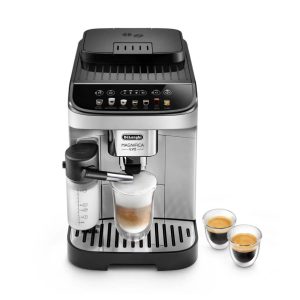
Price: $875.00 — Check current price on Amazon
The Magnifica Evo is the more complete drink machine. It offers 7 one-touch drinks — espresso, coffee, over ice, cappuccino, latte macchiato, My Latte, and hot water — through De’Longhi’s LatteCrema system, which stores as an auto milk carafe and textures milk without you holding a pitcher or watching a wand.
Its built-in conical burr grinder and 15-bar pump cover the basics, and the detail I weight most for ownership is the removable brew group. The brew group is where coffee oils and old grounds accumulate; being able to pull it out and rinse it is the difference between a machine that tastes clean in year three and one that slowly doesn’t.
The honest costs: the milk carafe, while automatic, has more parts and channels to clean than Philips’ LatteGo — budget a real wash, not a rinse. And like every fully automatic, the espresso is good, convenient espresso, not the equal of a dialed-in semi-automatic. You’re buying consistency and speed, and on those terms the Evo delivers the fuller menu.
Pros: 7 one-touch drinks, the widest menu here; LatteCrema auto milk carafe; removable brew group for real maintenance; built-in conical burr grinder; 2-year warranty.
Cons: Milk carafe takes more cleaning effort than LatteGo; larger commitment for households that only drink black coffee; no user profiles at this price.
Best for: Households that drink varied milk drinks daily and want the machine to handle all of it, start to finish.
Best for easy cleaning and quiet: Philips 3300 LatteGo (EP3341/50)
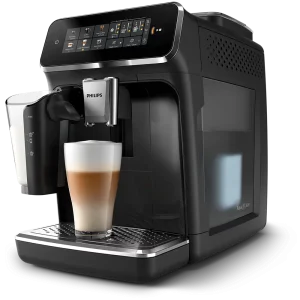
Price: $549.99 — Check current price on Amazon
The Philips 3300 is the current LatteGo machine — 6 hot and iced presets covering espresso, coffee, iced coffee, cappuccino, latte macchiato, and hot water, with a 15-bar pump, a ceramic grinder, a 1.8L water tank, and AquaClean filtration support.
Its party trick is still the LatteGo milk system itself: a small carafe made of just 2–3 parts with no tubes. Milk systems are where fully automatics live or die on hygiene, and this is the easiest one to clean in the class — rinse it, or put it in the fridge between uses, and you’re done. If you know you’ll skip a complicated wash, buy the machine whose wash you’ll actually do.
Philips also claims SilentBrew technology makes grinding 40% quieter, and whatever the exact number, quieter grinding is the feature early risers in shared houses will appreciate most. Add a full-color display, HomeID app support, and a narrower footprint than the Evo, and the 3300 is the easier machine to live around — it just offers one fewer drink preset and no equivalent to De’Longhi’s My Latte.
Pros: LatteGo carafe is tube-free, 2–3 parts, and the fastest milk system to clean; SilentBrew for quieter grinding; 6 hot and iced presets including iced coffee; full-color display and app support; narrower footprint.
Cons: 6 presets vs. the Evo’s 7, with no My Latte equivalent; ceramic grinder is durable but the drink menu is the smaller one; no user profiles at this tier either.
Best for: Milk-drink households that prioritize fast cleanup, quieter mornings, and a smaller counter footprint over maximum drink variety.
Head to head, in plain terms
- Milk cleanup: Philips, clearly. LatteGo’s tube-free design wins the chore you’ll do hundreds of times.
- Drink variety: De’Longhi, by a nose — 7 presets to 6, and My Latte tips it.
- Noise: Philips, on SilentBrew.
- Footprint: Philips is narrower; measure your counter either way, because both are real appliances.
- Long-term maintenance: De’Longhi’s removable brew group is a genuine ownership advantage, provided you actually rinse it on schedule.
Notice the pattern: there’s no sweep here. You’re choosing which daily friction you’d rather have less of — cleanup and noise, or a shorter menu and a brew group you can’t pull out.
FAQ
Is a fully automatic worth it over a semi-automatic like the Barista Express?
If you’ll use it every day and value one-touch convenience, yes — the per-drink cost beats cafés quickly and there’s almost no learning curve. If you enjoy the process or chase the best possible straight shot, a semi-automatic makes better espresso for less money. It’s convenience vs. ceiling, and only you know your mornings.
What happened to the Philips 3200 LatteGo?
It’s discontinued, replaced by the 3300 LatteGo in this guide. Remaining 3200 listings are old stock — don’t buy one at a new-model price, and expect support and parts to favor the current model.
How much cleaning do these really need?
Daily: empty the drip tray and grounds container, rinse the milk system. Weekly-ish: rinse the brew group where removable. Periodically: descale and replace filters as the machine prompts. The Philips wins the daily milk chore; neither machine is zero-maintenance, whatever the box implies.
Can a fully automatic make espresso as good as a café?
Good, fresh-bean, better-than-average-café drinks — yes, especially milk drinks. The best café shot from a skilled barista on a dialed-in semi-automatic or commercial machine — no. You’re trading the last stretch of quality for push-button consistency, and for most households that’s the right trade.
Verdict
Buy the De’Longhi Magnifica Evo if drink variety and maintainability lead your list — it’s the fuller-featured machine. Buy the Philips 3300 LatteGo if cleanup, quiet, and counter space lead yours — it’s the easier machine to live with. Either way, use fresh beans. A fully automatic with stale beans is an expensive way to make mediocre coffee quickly.