
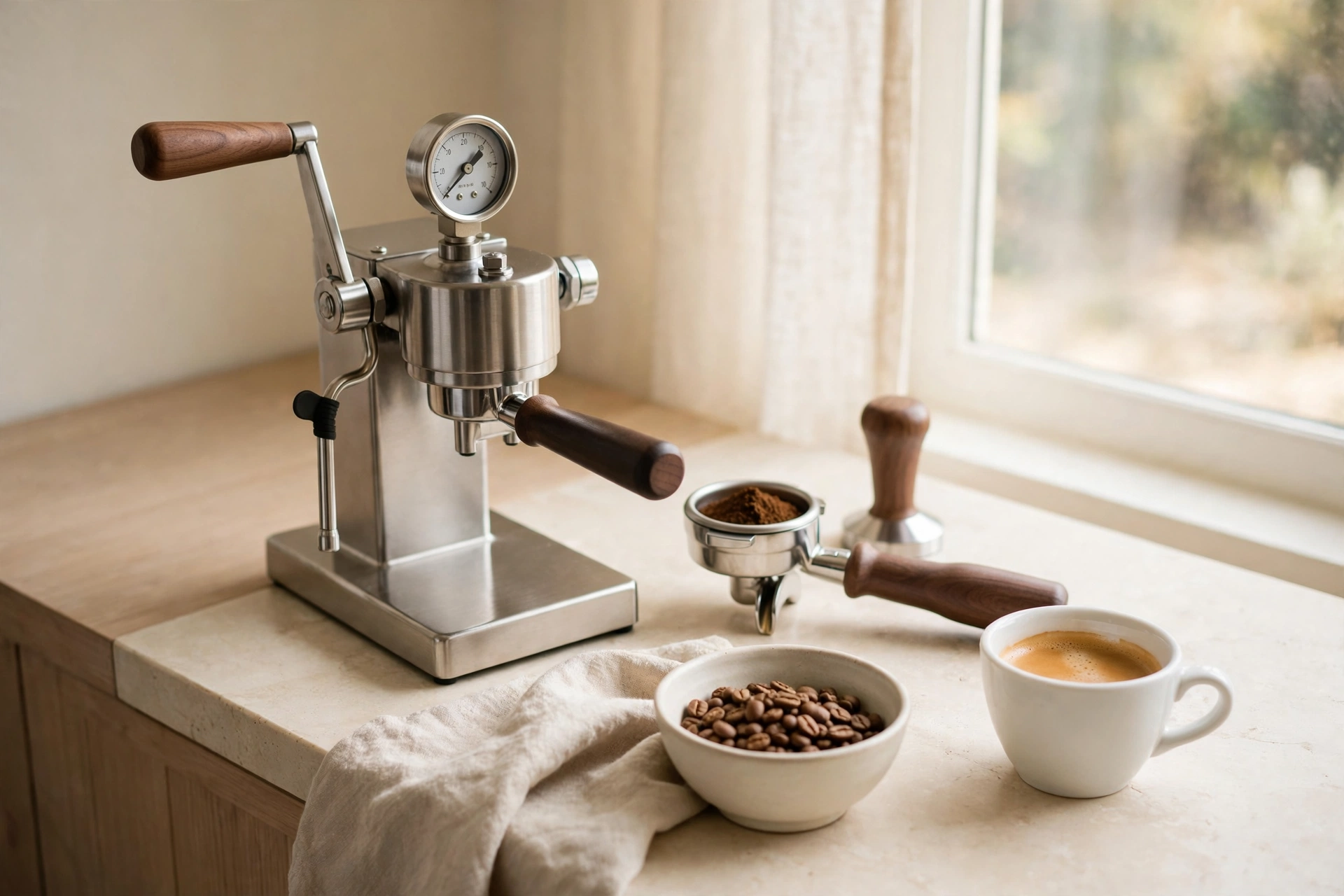
The names sound like a ladder — manual, semi-automatic, super-automatic — as if each step up is simply better. It is not. They are three different bargains about who does the work: you, or the machine. Pick wrong and you either get a hobby you did not want, or a push-button drink that never tastes like the café shot you hoped to copy.
The one difference that matters
All three types push hot water through finely ground coffee under pressure. The difference is control.
- Manual (lever) machines: you create the pressure yourself by pulling a lever. You control how fast the water flows and when the shot ends.
- Semi-automatic machines: an electric pump creates the pressure. You grind, dose, tamp, lock in the portafilter, and start and stop the shot yourself.
- Super-automatic machines: the machine does almost everything. You add beans and water, press a button, and it grinds, doses, tamps, brews, and — on many models — steams and pours the milk too.
Everything else — learning curve, taste ceiling, cleanup, and how involved your mornings feel — flows from that split.
Manual: total control, total responsibility
On a lever machine there is no pump. Your arm, through the lever, is the pump. That gives you control no other type offers: start gently, ease the pressure up, and slow it down near the end, feeling the resistance change as you pull.
Experienced lever users can pull exceptionally sweet, layered shots. It is also unforgiving. If the grind is a little off, the dose uneven, or your pull inconsistent, there is no steady pump to cover for it. The same shot pulled twice can taste different because you were different.
What your routine looks like: grind separately (most lever machines have no built-in grinder), dose and tamp, lock in, pull the lever with steady force for the length of the shot, then steam milk separately if you want it.
Best for: people who enjoy the process itself, want to learn by feel, and make one or two drinks at a time. Not for: rushed mornings, a household where several people need drinks back to back, or anyone who wants the same result without thinking about it.
Semi-automatic: the café method, at home
This is the type most cafés use, scaled down for a counter, and the type most home guides mean by “espresso machine.” The pump holds pressure steady; you handle everything around it.
You choose the dose, grind, distribute and tamp, lock in the portafilter, and decide when to start and stop the pump based on time and how much espresso is in the cup. Milk is steamed by hand on a wand, which takes practice but is how you get proper microfoam.
Because you control the variables, you can learn to fix a bad shot: too sour, grind finer or let it run longer; too bitter, do the opposite. That dialing-in process only works this directly on a semi-automatic (or a lever machine), because on a super-automatic the machine has already made those choices for you.
What your routine looks like: about a few minutes of active work per drink once you know the routine — grinding, puck prep, the shot itself, steaming milk, and knocking out and rinsing the portafilter.
Best for: beginners who actually want to learn espresso, and anyone chasing café-quality taste at home. It is the middle path: real skill to learn, but the highest taste ceiling for the effort most people are willing to give. If that is your direction, the machines in our guide to the best espresso machine for beginners are all this type, for exactly that reason.
Super-automatic: a coffee shop in one button
A super-automatic (often called fully automatic or bean-to-cup) hides the whole process inside the machine. An internal grinder doses into an internal brew group, the machine tamps, brews, and dumps the spent puck into a bin you empty later. Many models froth milk from a carafe or a panarello wand and build a latte or cappuccino from a menu button.
The strength is obvious: anyone in the house can make a decent drink in about a minute, with no training and almost no mess on the counter. For households making several milk drinks every morning, that consistency and speed are hard to beat.
The trade-offs are just as real. You give up most control over dose, grind, and shot length, so you can adjust taste only within the range the machine allows. Internal parts need regular rinsing, descaling, and emptying, and repairs are more complex because everything is integrated. The drinks are good and remarkably consistent, but they rarely match the best shot from a well-run semi-automatic using the same beans — the machine optimizes for convenience, not for the last bit of flavor.
What your routine looks like: fill the water tank and bean hopper when they run low, press a button, empty the drip tray and grounds bin, and follow the machine’s cleaning prompts.
Best for: busy households, people who mainly drink milk drinks, and anyone who knows they will not tamp, time, and steam by hand every day. Our roundup of the best fully automatic espresso machines covers this type in detail.
Side by side
| Manual (lever) | Semi-automatic | Super-automatic | |
|---|---|---|---|
| Who creates pressure | You, via a lever | Electric pump | Electric pump |
| Grinding and tamping | You, separately | You, by hand | Machine, internally |
| Starting and stopping the shot | You, by feel | You, by time and yield | Machine, by program |
| Milk | Steam wand, by hand | Steam wand, by hand | Automatic on many models |
| Learning curve | Steepest | Moderate | Lowest |
| Cleanup | Portafilter after each shot | Portafilter after each shot | Bins, trays, and prompted cleaning cycles |
| Taste ceiling | Very high, least consistent | Very high, more repeatable | Good and consistent, less adjustable |
Three honest questions to decide
Forget features for a moment and answer these instead:
- Do I want a ritual or a result? If making the drink is part of the pleasure, manual or semi-automatic. If the drink is the point and the making is a chore, super-automatic — honestly, not aspirationally.
- Will I still be doing this on a busy Tuesday in three months? A semi-automatic routine you abandon is worse than a super-automatic you use daily. Match the machine to your least patient morning, not your most enthusiastic Saturday.
- Who else will use it? If family or guests need to make drinks without a lesson, that points to super-automatic. If it is mainly you, and you like learning a skill, it points the other way.
The bottom line
Manual gives you the most control and demands the most from you. Semi-automatic splits the work sensibly — the pump handles pressure, you handle judgment — and is the right default for most people who want to learn real espresso. Super-automatic hands almost everything to the machine in exchange for speed, ease, and consistency, at some cost to control.
None of them is the advanced version of the others. Choose by how you want your mornings to feel, and the taste will follow from a machine you actually use well.