Quick picks:
- Buy the Baratza Encore ESP — if espresso is the main event and you want the easiest dial-in, the deepest support network, and a grinder you can repair for a decade
- Buy the Fellow Opus — if you single-dose, switch between espresso and filter coffee, and want the quieter, tidier, better-looking machine
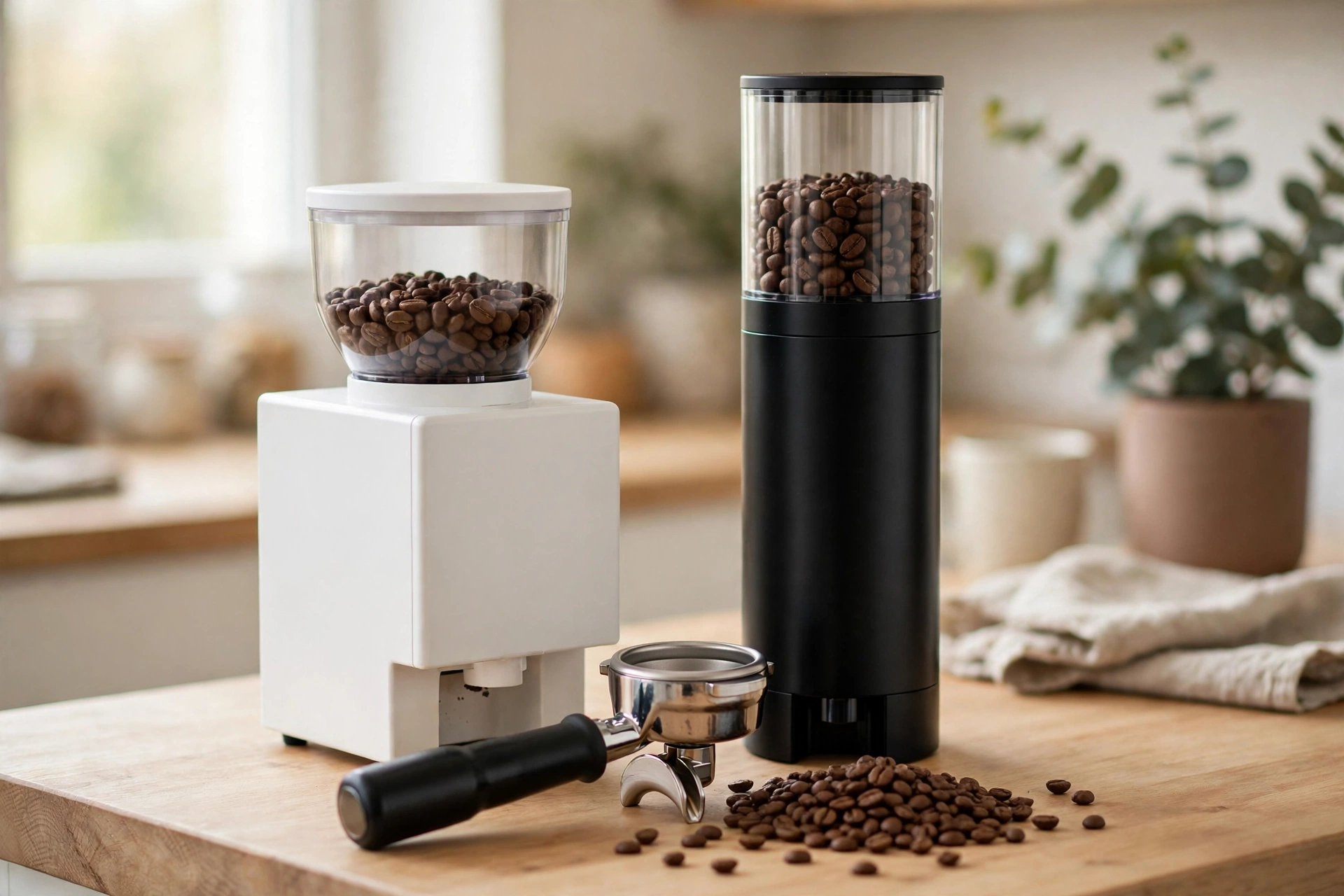
This is the head-to-head most buyers at $200 are actually deciding, and it is a genuinely close call — because both grinders cost exactly the same $199.95 and both can pull real espresso. There is no wrong answer here. There is, however, a right answer for your counter, and it comes down to how you make coffee, not which spec sheet wins.
The short version: the Encore ESP is the espresso specialist with a wrench-friendly soul. The Opus is the all-rounder designed like a piece of kitchen decor. Here is how they separate once you live with them.
At a glance
| Baratza Encore ESP | Fellow Opus | |
|---|---|---|
| Price | $199.95 | $199.95 |
| Burrs | 40mm conical (M2) | 40mm conical (C6-40, 6-blade) |
| Designed for | Espresso-first, filter-capable | True all-rounder, espresso to French press |
| Adjustment | 40 steps — steps 1–20 are fine micro-steps for espresso | 41+ settings plus an inner ring for fine espresso tuning |
| Workflow | Hopper-based, grind into bin or portafilter | Single-dose friendly, magnetic catch cup |
| Retention / mess | Moderate; some static in the bin | Low retention; anti-static design, cleaner counter |
| Noise | Loud for its class | Noticeably quieter |
| Repairability | Every part sold, legendary support | Sealed, modern appliance model |
Dialing in espresso
This is the test that decides most purchases, and the Encore ESP wins it on simplicity. Baratza re-geared the original Encore so that the first 20 steps of its range are high-resolution micro-steps dedicated to espresso. You turn the hopper, you land in espresso territory immediately, and each click makes a small, predictable difference. For a beginner learning to dial in — chasing a 25–30 second shot and adjusting one variable at a time — that predictability is worth real money. It is the grinder this site already recommends in our under-$200 grinder guide, for exactly this reason.
The Opus can absolutely dial in espresso, but it asks more of you. Its main dial covers the full range from espresso to cold brew across 41-plus settings, and fine espresso adjustments involve an inner adjustment ring inside the burr chamber. Once you learn the system, it works — and experienced users make excellent espresso with it daily. But the learning curve is real, and adjustments feel less direct than the Encore ESP’s dedicated espresso steps.
Edge: Encore ESP — especially for espresso beginners.
Everything else you brew
Reverse the test and the Opus pulls ahead. If your mornings rotate — espresso on weekdays, pour-over on Saturday, French press when family visits — the Opus was designed for exactly that life. Its grind range is wide and genuinely usable at both ends, the single-dose workflow suits switching beans and methods, and the magnetic catch cup and anti-static touches keep the counter clean through all of it.
The Encore ESP can grind for filter coffee — the upper half of its range exists for that — but its heart is at the fine end. Hopper-based grinding also suits a household that drinks one bean, one way, every day. If that is you, the ESP’s simplicity wins again. If variety is the point, the Opus is the more natural tool.
Edge: Opus — for multi-method brewers and single-dosers.
Workflow, noise, and living with them
The Opus is the one you would leave out on the counter in a design magazine, and the one your household will complain about less: it is noticeably quieter, more compact in feel, and tidier shot-to-shot thanks to low retention and anti-static design. Low retention matters if you single-dose — what you weigh in is close to what you get out, without yesterday’s grounds in today’s cup.
The Encore ESP is louder, boxier, and its grounds bin collects static cling. In exchange, you get the most repairable grinder in its class. Baratza sells replacement burrs, motors, and small parts, publishes repair guides, and has built its reputation on keeping decade-old grinders running. The Opus follows the modern sealed-appliance model: sleeker, but when something fails out of warranty, replacement is the path, not repair.
Neither approach is wrong. They are different bets: the Opus bets on design and daily pleasantness; the Encore ESP bets on longevity and serviceability.
Edge: Opus for daily experience. Edge: Encore ESP for long-term ownership.
The sidebar option: Breville Smart Grinder Pro
One more name belongs in this conversation. The Breville Smart Grinder Pro at $199.95 costs exactly the same as both grinders above — it used to undercut them, but its price has moved up to meet them — with timed dosing and the simplest controls of the three. At the old price it was the budget alternative; at price parity, the comparison is purely about the grinding. Its espresso adjustment steps are coarser than the Encore ESP’s dedicated micro-steps, and its grinds can clump at the finest settings. If you value Breville’s timed dosing and control layout above dial-in precision, it is a fair buy at the same money. If espresso quality is the priority — and at $200, it should be — the Encore ESP and Opus are the real contest.
FAQ
Are the Encore ESP and Opus really the same price?
Yes — both are listed at $199.95. That is what makes this a pure priorities decision: you are not paying a premium for either design philosophy.
Which is better for a complete espresso beginner?
The Encore ESP. Its dedicated micro-steps make dialing in a learnable, repeatable process, and Baratza’s support and parts availability forgive beginner mistakes — including the broken part you can simply order and replace.
Can the Fellow Opus really do espresso, or is it a filter grinder in disguise?
It really does espresso. Fellow built it as a true all-rounder with a dedicated inner ring for fine adjustment. It takes more learning than the Encore ESP, but owners pull quality shots with it every day.
Which grinder will last longer?
On design philosophy, the Encore ESP: it is built to be opened, repaired, and kept. Baratza’s track record of supporting old machines is unmatched at this price. The Opus is well-built, but as a sealed modern appliance it is not designed for a decade of home repair.
Verdict
Buy the Baratza Encore ESP at $199.95 if espresso is your main drink, you are learning to dial in, or you want the grinder most likely to still be running — and repairable — in ten years. Buy the Fellow Opus at $199.95 if you single-dose, rotate between espresso and filter methods, and value a quieter, cleaner, better-looking daily routine. Same money, two honest philosophies: the specialist you can fix, or the all-rounder you will enjoy looking at. Choose by how you actually make coffee, and either one will serve you well.
Prices confirmed November 16, 2026 — check the current price on Amazon before you buy, as prices move.