
Quick picks:
- Best under $50 — and under $25: Mercer Culinary Millennia 8-Inch Chef’s Knife — the professional-kitchen workhorse that costs less than a takeout dinner
- Best step-up under $50: Mercer Culinary Genesis 8-Inch Chef’s Knife — Mercer’s forged line, for cooks who want a heavier knife with a bolster
This guide has two picks, and both wear the same brand — that is the honest state of the under-$50 chef’s knife market right now. Mercer Culinary’s two lines, the stamped Millennia and the forged Genesis, cover the bracket so completely that everything else at this price is either a clear step down or has drifted over the line.
For years, the standard outside advice was a two-horse race between the Mercer Culinary Millennia and the Victorinox Fibrox Pro. That race is over for this price bracket — not because the Victorinox got worse, but because its price moved. It now sits at $57.71, over the $50 cap in this guide’s title, so it appears below only as a note, with no link and no pick status. I would rather publish a short, true guide than stretch the title to fit a knife that no longer fits it.
What is left standing is genuinely excellent. The Millennia is the knife line cooks buy with their own money, and at under $20 it is not a compromise pick. It is the pick. The Genesis is what you buy when you want the forged-knife feel — weight, bolster, presence — without leaving the bracket.
What to look for in a chef’s knife under $50
- Steel that sharpens easily: At this price you want high-carbon stainless steel that takes an edge quickly on a basic stone or honing rod and does not chip. Exotic hard steels are the wrong trade here — you want forgiving, maintainable steel.
- Stamped is fine — and forged exists here too: Most knives under $50 are stamped (cut from a sheet of steel) rather than forged, and a well-made stamped knife with good geometry cuts better than a heavy, poorly balanced forged one. This bracket has one genuine forged option — the Genesis below — so judge the cut, not the construction label.
- Grip over looks: A textured, non-slip handle matters more than wood grain or bolster styling. The best budget knives come out of commercial kitchens, where the handle has to work with wet hands for a full shift.
- Edge geometry: A thin blade behind the edge glides through onions and root vegetables instead of wedging them apart. This is where the Mercer quietly beats prettier knives costing twice as much.
- NSF certification as a tell: Knives certified for commercial food service have to meet sanitation and durability standards. It is a useful shortcut at this price: if a knife is built to survive a restaurant, your home kitchen is easy duty.
The picks
Best under $50: Mercer Culinary Millennia 8-Inch Chef’s Knife (M22608)
$19.99
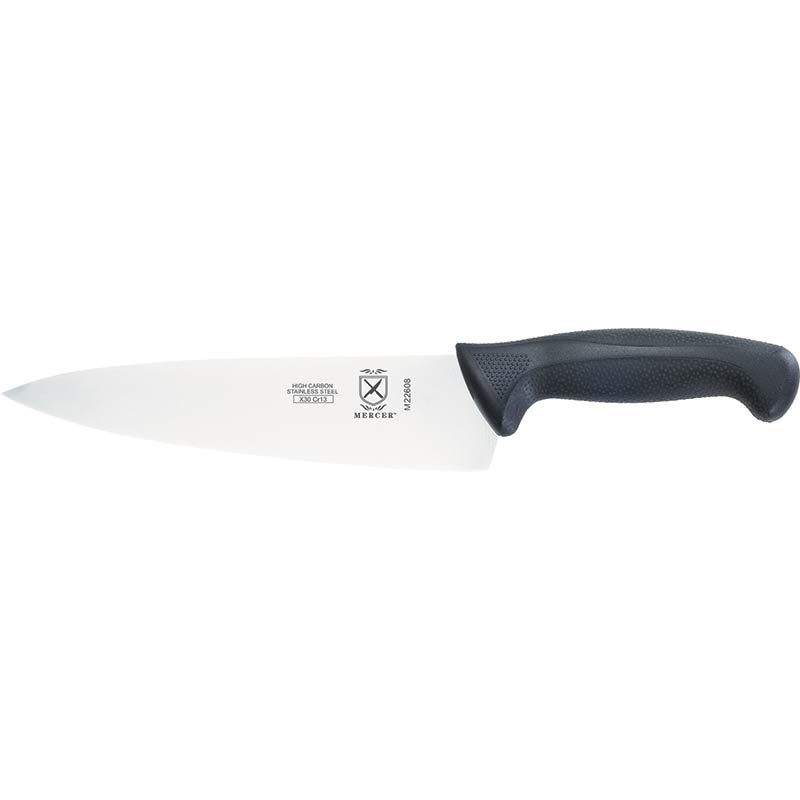
The Millennia is the chef’s knife from Mercer Culinary’s commercial line — the knives culinary students are issued and line cooks replace, year after year, because nothing else at the price does the job as well. It is NSF certified, built for professional kitchens, and priced like a grocery-store knife.
The blade is high-carbon Japanese stainless steel, stamped, with a thin profile that moves through onions, carrots, and chicken without the wedging you get from thick budget blades. It arrives properly sharp, and — this is the part that matters over years of ownership — it is easy to bring back. A few passes on a honing rod restores the working edge, and when honing stops being enough, the steel sharpens quickly on an inexpensive stone. Softer, forgiving steel is a feature at this price, not a flaw: it resists chipping and rewards basic maintenance.
The handle is the other half of the argument. The Millennia’s textured polypropylene grip, with a finger guard built in, stays secure with wet or greasy hands in a way that smooth, handsome handles do not. It is not a beautiful knife. It is a tool, shaped by people who use one for a living, and your hands will understand the design within one onion.
Balance is neutral and the knife is light, which suits long prep sessions and cooks who find heavy forged knives tiring. If you want a knife that feels like a weapon, this is not it. If you want a knife that disappears into the work, it is.
Pros: Extraordinary value at under $20; thin, easy-cutting blade geometry; genuinely non-slip commercial grip; NSF certified; sharpens fast and forgives basic technique; light and balanced for long prep.
Cons: Stamped construction feels less premium than forged knives; plain working-knife looks; edge needs regular honing — the steel trades hardness for toughness and ease of sharpening; no bolster, which some cooks prefer for the pinch grip transition.
Best for: Almost everyone shopping under $50 — beginners building real skills, experienced cooks who want a beater that performs, and anyone outfitting a kitchen on a real budget.
Best step-up under $50: Mercer Culinary Genesis 8-Inch Chef’s Knife (M20608)
$40.00
The Genesis is Mercer Culinary’s forged line — the same company, a different philosophy. Where the Millennia is stamped and light, the Genesis is forged from high-carbon German steel (X50CrMoV15, the workhorse steel of European kitchen knives) and finished with a full bolster: the thick collar of steel between blade and handle that adds weight, protects the fingers, and gives the pinch grip a natural resting place.
In the hand, the difference is immediate. The Genesis feels like a traditional European chef’s knife — heavier, more deliberate, with the balance point sitting where forged-knife cooks expect it. The edge geometry is a touch thicker than the Millennia’s, so it wedges slightly more in dense root vegetables, but it shrugs off hard use — winter squash, chicken joints, frozen-adjacent mistakes — that you would baby a thinner blade through. The Santoprene handle is softer and more cushioned than the Millennia’s polypropylene grip, and stays secure with wet hands.
It is also, like the Millennia, NSF certified and built for commercial kitchens — this is the knife Mercer sells to cooks who want the forged experience on a working budget. At $40.00 it costs exactly twice the Millennia, and the honest question is what the extra $20 buys: not a better cut on an onion, but weight, a bolster, and the feel of a traditional forged knife. For cooks raised on that feel, it is worth every cent. For everyone else, the Millennia exists.
Pros: Genuine forged construction under $50; full bolster and traditional forged balance; tough German high-carbon steel that takes hard use; cushioned non-slip Santoprene handle; NSF certified.
Cons: Twice the Millennia’s price for feel rather than cutting gains; slightly thicker geometry wedges more in dense vegetables; heavier — tiring for cooks who prefer a light knife.
Best for: Cooks who want a traditional forged chef’s knife — weight, bolster, presence — without leaving the under-$50 bracket.
A note on the Victorinox Fibrox Pro — over the line now
The Victorinox Fibrox Pro 8-inch chef’s knife has been the other half of this recommendation for years, and the knife itself has not changed: it is still light, sharp, and fitted with one of the most comfortable non-slip handles at any price. What changed is the price. It was $46.00 when this site first confirmed it, and it has since moved to $57.71 — over the $50 cap in this guide’s title.
So it is not a pick here, and there is deliberately no buying link on it in this article. If your real budget is “under $60,” it remains a knife worth your own search, and this site covers it in our beginner chef’s knife guide. But a guide titled “under $50” that leads with a $57.71 knife would not be honest, and the Mercer below it on price gives up very little in the cut to justify stretching.
How to make a $20 knife perform for years
A budget knife plus a basic routine beats an expensive knife neglected — this is not a slogan, it is the whole economics of this price tier:
- Hone weekly (or before any big prep session) with a standard honing rod. Honing realigns the edge; it does not remove steel.
- Sharpen when honing stops working — for most home cooks, a few times a year on a whetstone or with a pull-through sharpener kept for this class of knife.
- Hand wash and dry immediately. Dishwasher heat, detergent, and rattling are edge killers at every price.
- Store it protected: a magnetic strip, a blade guard, or a block — never loose in a drawer.
- Cut on wood or plastic, not glass, stone, or metal surfaces.
Follow that, and the Millennia’s “cheap knife” reputation inverts: it will out-cut dull premium knives in most home kitchens, because most home knives are dull.
FAQ
Is a $19.99 chef’s knife really good enough for daily cooking?
Yes. The Millennia is a commercial-kitchen knife, not a novelty item. Its steel, geometry, and grip are designed for professional daily use. What you give up versus premium knives is edge retention between sharpenings and fit-and-finish — not cutting ability.
Why are both picks from the same brand?
Because Mercer Culinary’s two lines honestly cover this bracket: the stamped Millennia wins on value, and the forged Genesis is the one genuine forged option under $50. The other long-standing pick at this price, the Victorinox Fibrox Pro, has moved to $57.71 — over the $50 cap — so it is covered here as a note rather than a pick.
Stamped or forged — should I care under $50?
Less than marketing suggests. A thin, well-shaped stamped blade (the Millennia) cuts better than a thick budget forged blade, and the weight savings suit most home cooks. Forged construction — the Genesis — buys weight, a bolster, and traditional feel. Pick by the feel you prefer, not by the label.
What else do I need besides the chef’s knife?
Start with just the chef’s knife and a honing rod. Add a paring knife when small in-hand work frustrates you, and a serrated bread knife when crusty loaves enter your life. Buying one good knife at a time beats a cheap block set — see our knife set guide for why.
Verdict
Buy the Mercer Culinary Millennia 8-Inch at $19.99 for the best value under $50 — it wins on blade geometry, grip, maintainability, and a commercial track record, at a price that leaves room in the budget for the honing rod and cutting board that will make it perform. Buy the Mercer Culinary Genesis 8-Inch at $40.00 if you want the forged version of the same idea: heavier, bolstered, traditional. If your budget stretches past $50, the Victorinox Fibrox Pro at $57.71 is the step-up to research next.
Prices confirmed November 16, 2026 — check the current price on Amazon before you buy, as prices move.