The short version:
- Buy the Breville Barista Express Check current price on Amazon if you want one box that grinds, brews, and steams — unbox it and make a latte in 20 minutes.
- Buy the Gaggia Classic Evo Pro Check current price on Amazon if you want the better long-term machine and don’t mind buying a separate grinder.
These are the two most recommended machines in home espresso, and they represent opposite philosophies. This isn’t really a “which is better” question — it’s a “which kind of buyer are you” question.
Tale of the tape
| Breville Barista Express | Gaggia Classic Evo Pro | |
|---|---|---|
| Price | $499.95 | $450.83 |
| Grinder | Built-in conical burr | None — buy separate (~$150–200) |
| Portafilter | 54mm | 58mm (commercial standard) |
| Heat-up | Fast, under a minute | 10–15 minutes |
| Solenoid valve | No | Yes (3-way) |
| True all-in cost | ~$500 | ~$600–650 with grinder |
(Note: the Evo Pro is the current model in Gaggia’s Classic line — it replaced the older Classic Pro with an updated boiler and quieter pump. If you see “Classic Pro” in older reviews, this is the machine they’re talking about.)
Breville Barista Express: the one-box solution
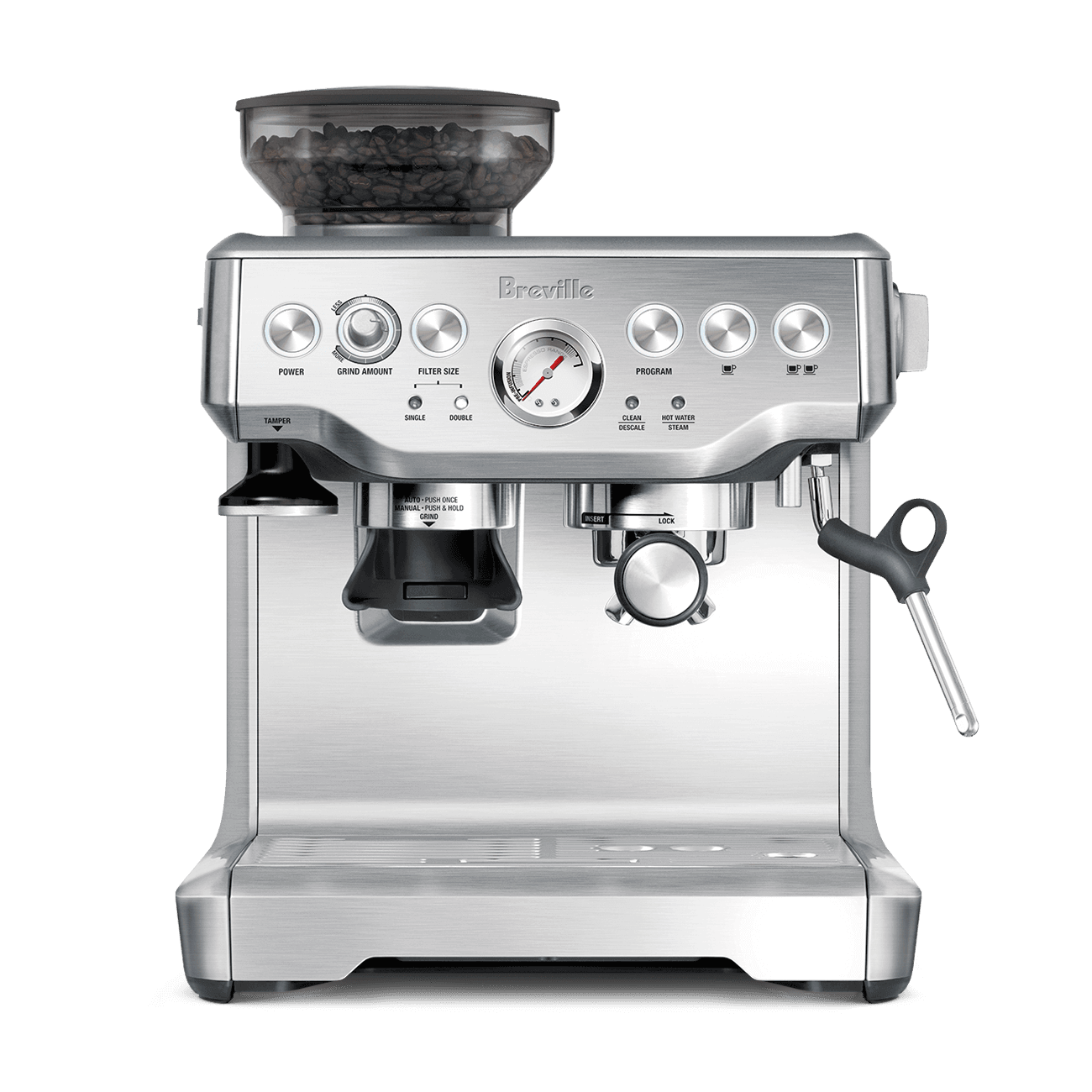
$499.95 Check current price on Amazon
The Barista Express is the best-selling espresso machine in its class for a reason: it’s the complete package. Conical burr grinder built into the top, dose-control grinding straight into the portafilter, fast heat-up, and a steam wand that produces genuinely good microfoam. You go from box to latte in under half an hour, and the learning curve is gentle — the pressurized dual-wall baskets it ships with forgive bad technique while you learn.
The catch is the thing that makes it convenient: the grinder. It’s decent, but it’s the weakest part of the machine, and you can’t upgrade it without replacing the whole unit. In two years when your palate outgrows it, your options are “live with it” or “buy a whole new setup.” Breville also isn’t built for repair — when something major fails out of warranty, it’s usually a replacement, not a fix.
Pros: Everything in one box; fastest path from zero to good coffee; forgiving for beginners; compact footprint.
Cons: Built-in grinder can’t be upgraded; 54mm portafilter isn’t the industry standard; not meaningfully repairable long-term.
Best for: The buyer who wants great coffee this week, not a hobby.
Gaggia Classic Evo Pro: the long-term platform
$450.83 Check current price on Amazon
The Classic has been the default recommendation in espresso forums for 30 years. 58mm commercial-standard portafilter, 3-way solenoid valve (dry pucks instead of soupy messes), and a single boiler built like industrial equipment. It’s the machine people still use a decade later — and when something wears out, you replace a $20 gasket, not the machine.
The price is misleading, though: $450.83 gets you the machine, not the setup. You need a grinder ($150–200 for espresso-capable), and you need patience — 10–15 minute heat-up, and the stock machine requires “temperature surfing” (a timing trick to hit the right brew temp) until you add a PID controller. The modding community is enormous — PID kits, pressure gauges, low-profile drip trays — which is either a selling point or a warning depending on who you are.
Pros: Commercial-standard 58mm parts; huge mod support; repairable for decades; better ceiling as your skills grow.
Cons: No grinder included (real cost ~$600–650); slow heat-up; steeper learning curve out of the box.
Best for: The buyer who wants to learn real espresso and keep the machine for 10 years.
The grinder math (read this before deciding)
Here’s the honest comparison nobody puts in the headline: the Barista Express at $499.95 includes a grinder. The Gaggia at $450.83 needs one — a Baratza Encore ESP or equivalent runs ~$150–200, bringing the real total to ~$600–650.
So the money is nearly identical. You’re not choosing between cheap and expensive — you’re choosing between convenience now (Breville: good grinder locked in forever) and ceiling later (Gaggia: buy your own grinder, upgrade it whenever you want, keep the machine for a decade).
One more thing the spec sheets won’t tell you: the single biggest upgrade path in espresso is the grinder, not the machine. Gaggia owners upgrade grinders twice and keep the machine. Barista Express owners eventually replace the whole thing. Plan accordingly.
FAQ
Which one makes better espresso?
With a good grinder and practiced technique, the Gaggia has the higher ceiling — 58mm commercial parts and temperature control (especially with a PID mod) win. Out of the box on day one, the Breville is easier to get good results from.
I’m a total beginner — which should I get?
The Breville, unless you already know you want the hobby. The Gaggia punishes beginners; the Breville forgives them.
Can I use pre-ground coffee with either?
Technically yes, practically no. Espresso needs fresh-ground beans — pre-ground goes stale too fast to pull a good shot. If you won’t buy a grinder, get the Breville (built-in) and use fresh whole beans.
Which lasts longer?
The Gaggia, by a wide margin. It’s designed to be serviced. The Breville is designed to be replaced.
Verdict
Buy the Breville Barista Express if you want the shortest path to great coffee and don’t care about upgrading piecemeal. Buy the Gaggia Classic Evo Pro if you’re buying into the hobby — accept the separate grinder and the learning curve, and you’ll own a machine that outlasts three Brevilles.
Still deciding on budget? See our best espresso machines under $500 guide — and if milk drinks are your thing, our best espresso machines for lattes breaks down which of these steams better.