
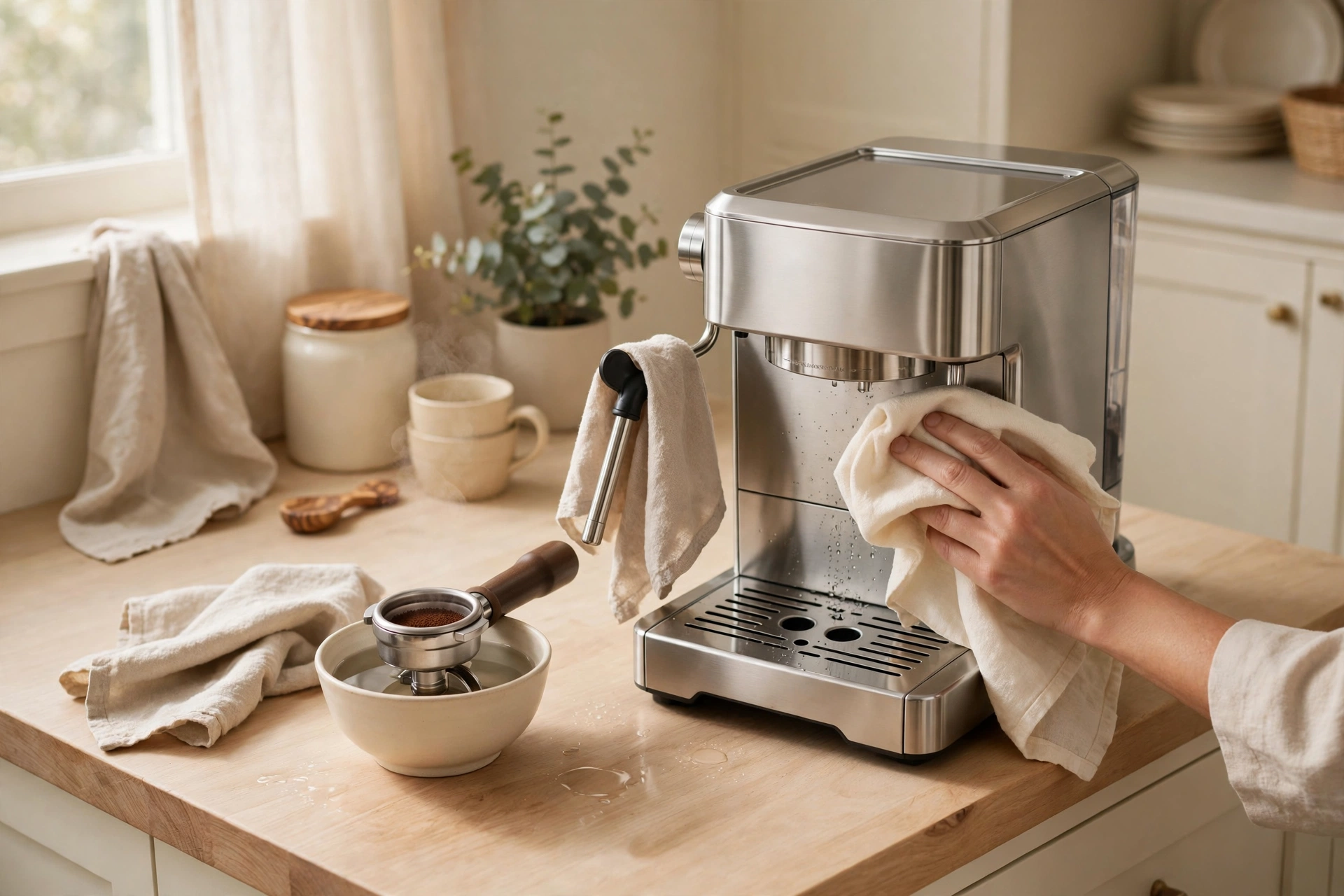
Your espresso machine doesn’t usually fail all at once. It gets a little slower, a little more bitter, a little harder to dial in — until one morning the shot tastes off and you can’t figure out why. Most of the time it’s not the beans or your technique. It’s buildup: old coffee oils on the shower screen, milk baked onto the steam wand, and mineral scale inside the boiler and lines.
Cleaning and descaling are two different jobs, and confusing them is where most beginners go wrong. Cleaning removes coffee oils and residue. Descaling removes mineral scale. You need both, on different schedules, and neither is complicated once you split the work into daily, weekly, and periodic habits.
Cleaning vs descaling: what’s actually building up
Coffee oils coat everything hot water touches after the puck: the basket, portafilter, shower screen, and group head. Left alone, they go rancid and taste bitter and stale even in a well-pulled shot. No amount of adjusting grind or dose fixes that. If your shots turned harsh gradually and dialing in your espresso stops helping, clean first, then dial in again.
Milk residue is more urgent. Milk dries fast on a hot steam wand, clogs the tip holes, harbors bacteria, and changes steam performance — which changes your milk texture.
Scale is mineral deposits, mostly calcium and magnesium from your water, building up inside the boiler, thermoblock, valves, and narrow water paths. You can’t see most of it. Signs include slower flow, less steam pressure, inconsistent temperature, or a descale alert. Hard water scales much faster than soft or filtered water, so two owners with the same machine can need completely different schedules.
Detergent does not remove scale, and descaler does not remove coffee oils. Use each for its own job.
After every use: the 60-second routine
- Knock out the puck promptly. Don’t leave a spent puck sitting for hours — it dries, sticks, and leaves oils behind.
- Rinse the basket and portafilter under hot water and wipe dry. If coffee is baked on, use a soft brush, never a metal scouring pad.
- Flush the group head for a few seconds without the portafilter to rinse the shower screen.
- Purge and wipe the steam wand immediately. Blast steam for 1–2 seconds to clear milk from inside the tip, then wipe the outside with a damp cloth. If milk has dried, soak the tip in hot water to soften it — don’t chip at it. Good wand care keeps your milk texture consistent; if steaming has gotten weak or sputtery, revisit how to steam milk for latte art.
- Empty and rinse the drip tray and wipe the exterior.
If you build only one habit, build the steam wand one.
Weekly: a deeper clean
Once a week — or after roughly 30–50 shots if you pull several a day:
- Soak removable parts. Baskets, portafilter head (not a wooden handle), drip tray, and other parts the manual allows can soak in hot water with espresso machine detergent made for coffee oils. Follow the dilution and soak time, rinse thoroughly, and dry. Any detergent taste in the next shot means you didn’t rinse enough.
- Scrub the shower screen and gasket. Use a group head brush angled up around the rubber gasket the portafilter locks against. Grounds collect there and prevent a good seal.
- Wash the water tank with warm soapy water, rinse well, and refill with fresh water.
- Clean the grinder path. Brush out the burr chamber and chute as the manual directs, and wipe the hopper if oils have built up. Don’t wash burrs with water unless the manufacturer explicitly says to.
Backflushing: only if your machine is built for it
Backflushing pushes detergent water back through the group head using a blind basket. It cleans internal paths you can’t reach — but only on machines with a three-way solenoid valve designed for it.
Check your manual first. If your machine doesn’t support it, don’t improvise one; you can damage valves. Machines that don’t backflush still benefit from soaking, brushing, and flushing, and some use a cleaning disc or a manufacturer-specific cycle instead.
For machines that do: insert the blind basket, add the detergent amount the product directs, lock in, and run the pump in the short cycles your manual specifies. Then repeat with plain water until it runs completely clear. Your model’s instructions always win.
How to descale, step by step
Descale when your machine alerts you, when flow or steam noticeably drops, or on the interval your manual recommends for your water hardness. For many home users that’s every 2–3 months with hard water, less often with filtered water — a general range, not a rule for your machine.
- Check the manual first. Some boilers require a specific descaler, and some manufacturers warn against certain home mixtures. Use an espresso machine descaler (typically citric-acid based) unless your manual says otherwise. Don’t default to vinegar — some makers advise against it, it can affect taste and seals, and it needs far more rinsing.
- Remove water filters and empty the tank if directed. Filters can absorb descaler and reduce its effect.
- Mix and fill exactly as directed, and place a large heat-safe container under the group head and steam wand.
- Run the descale program if your machine has one and let it finish without interrupting.
- If there’s no program, run solution through the group and steam/hot-water paths in stages as directed, with the dwell time specified. Don’t rush the dwell — that’s when the work happens.
- Rinse aggressively. Wash the tank, refill with clean water, and flush at least a full tank through both paths. Taste plain hot water from the machine: if it tastes sour or chemical, rinse again.
- Replace the filter, refill, and pull and discard a first test shot. It should taste clean, not sharp or soapy.
Never leave descaling solution sitting overnight unless the procedure explicitly says to.
Fully automatic machines are a little different
Super-automatics hide most parts inside, so the manual matters even more. The brew unit on many models slides out for rinsing — do that on schedule, let it dry fully before reinstalling, and don’t use detergent on it unless directed. Milk carafes and tubes need their own cleaning cycle after use; milk left in a tube will spoil the next drink even if the espresso side is spotless. Don’t dismiss a descale or filter alert for weeks.
Make scale less of a problem
Use filtered water that still tastes good — completely mineral-free water makes flat espresso and some machines can’t sense it properly. Replace in-tank filters on schedule, and refill with fresh water rather than endlessly topping up old water. If your tap water is very hard, filtering does more for machine life than any cleaning product.
A simple schedule
- Every use: knock out puck, rinse basket, flush group, purge + wipe steam wand
- Weekly: soak baskets/portafilter, brush shower screen and gasket, wash water tank and drip tray
- Monthly or as needed: backflush if supported, deep-clean grinder path
- Every 2–3 months or on alert: descale, adjusted for your water and manual
- As prompted: replace water filter; check the group gasket — a worn gasket is a replacement, not a cleaning problem
The bottom line
Clean for taste today, descale for performance over time. Sixty seconds after each shot prevents the weekly job from becoming a rescue job, and descaling on schedule prevents the slow decline people mistake for a dying machine or bad beans. When in doubt, follow your model’s manual over any general guide — including this one — because boilers, valves, and warranties differ. Keep the routine small and regular, and your machine will make the same shot in month twelve that it made in month one.