
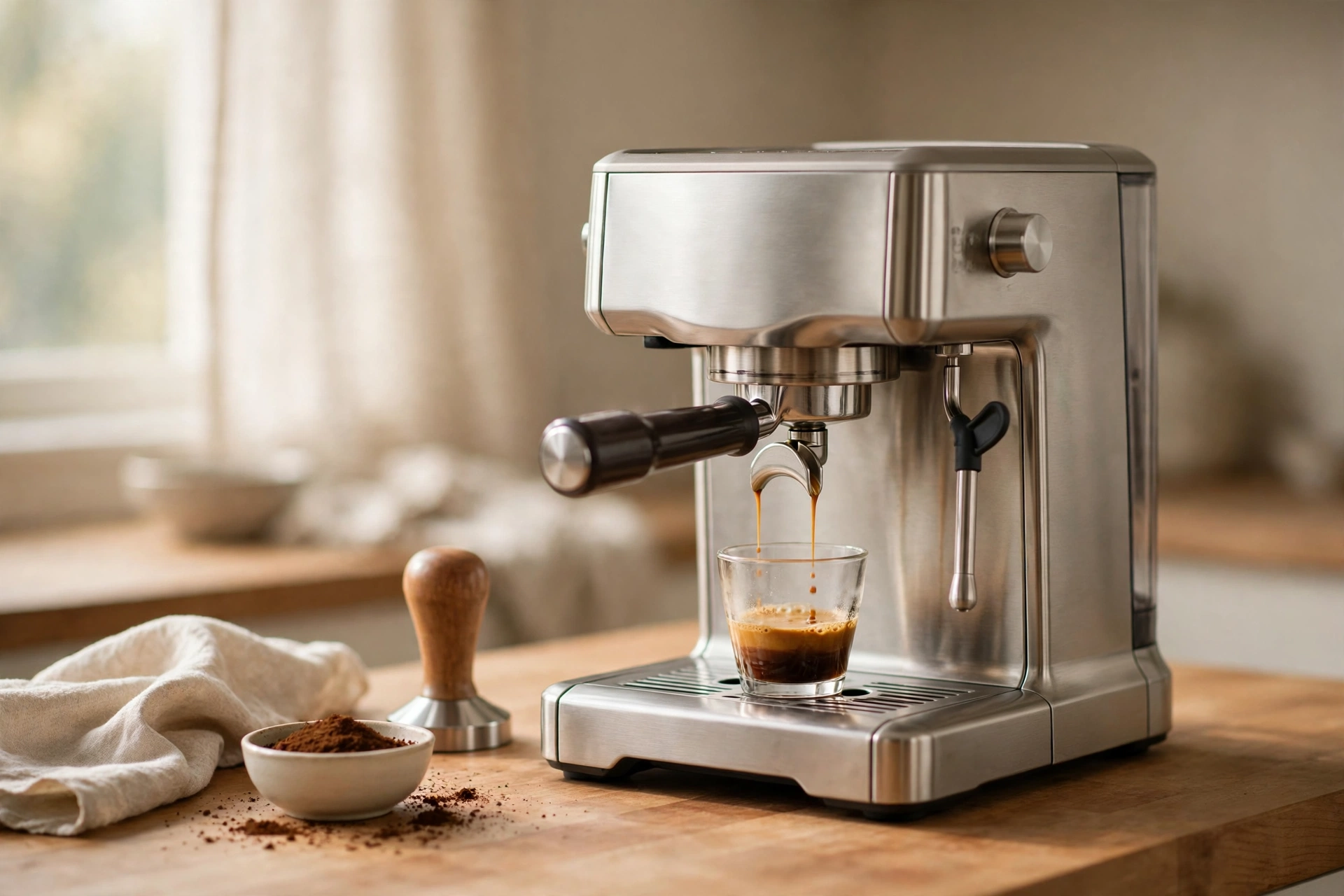
Your shot starts fine, then a thin jet spurts sideways, the stream turns pale early, and the cup tastes sour and bitter at the same time. That is channeling — and it is one of the most common reasons good beans and a good machine still produce a bad shot.
Channeling is not a mysterious machine fault. It is water taking the easiest path through the coffee puck instead of flowing evenly through all of it. Fix the path, and the same dose and grind that tasted harsh can taste balanced on the very next shot.
What channeling actually is
When you lock in a portafilter, pressurized water has to pass through a compacted bed of ground coffee. Water always follows the path of least resistance.
If the puck has a crack, a thin spot, a clump, or a gap at the edge, water rushes through that weak spot first. That area gets over-extracted — too much is pulled from too little coffee, too fast. The rest of the puck gets under-extracted, because most of the water bypassed it.
That split is why a channeled shot can taste sour and bitter in the same sip: under-extracted coffee tastes sour and salty, over-extracted coffee tastes bitter and hollow. You are not imagining the contradiction. You are tasting two different extractions at once.
How to spot channeling
You do not need special equipment to diagnose it, but a bottomless (naked) portafilter makes it obvious. Watch for:
- Spurts and jets: thin streams spraying off-center or sideways instead of a single steady stream merging in the middle.
- Early blonding in one spot: part of the stream turns pale yellow-white well before the rest, often in the first half of the shot.
- A fast, uneven flow: the shot starts normally, then suddenly speeds up as a channel opens.
- A puck with holes afterwards: knock the puck out and look — small holes, cracks, or a crater where water punched through.
- That sour-bitter taste: the clearest sign of all, even if the shot time looked about right.
With a standard spouted portafilter you cannot see the jets, so lean on time, taste, and the spent puck. If the shot ran fast, blonded early, and tastes both sour and harsh, assume channeling until proven otherwise.
The main causes, in the order to check them
Work through these in order. Most channeling is puck preparation, not grind size, and changing the grind first often hides the real problem.
1. Uneven distribution before tamping
This is the biggest cause. If grounds pile up in the middle, clump in one corner, or leave a thin edge, tamping just compacts an uneven bed. The thin areas become channels.
Shake or stir the grounds in the basket to break up clumps and level the bed before you tamp. A few seconds of distribution — stirring with a thin tool, or tapping the portafilter sides to settle the grounds flat — does more to stop channeling than any tamping trick.
2. An uneven or angled tamp
If you press harder on one side, the puck is denser on that side. Water avoids the dense side and rushes through the looser side. Tamp on a flat surface, keep your wrist straight, and aim for level, not maximum force. Consistent pressure matters; extreme pressure does not fix an uneven bed.
3. Clumps straight from the grinder
Static and moisture can make grounds clump, especially with darker roasts. A clump is dense inside and loose around it — a ready-made channel waiting to open. Break clumps up during distribution rather than tamping over them. If clumping suddenly gets worse, check whether your beans or your kitchen humidity changed before you blame your technique — storage and freshness affect how coffee grinds, too.
4. A dose that does not fit the basket
Too little coffee in a basket leaves a thin puck that cracks easily and leaves a gap between the puck and the shower screen, so water can pool and punch through. Too much coffee, and the puck can press against the shower screen and fracture when it expands.
Use the dose your basket is rated for as your starting point, and keep it consistent while you troubleshoot. Changing dose, grind, and prep all at once tells you nothing. The stable framework in how to dial in espresso — change one variable at a time — is what makes channeling fixes stick.
5. Knocking or bumping the portafilter after tamping
A tamped puck is fragile. Knocking the portafilter against the grinder fork, the counter, or the group head can crack it or pull it away from the basket wall, opening an edge channel you will never see. After tamping, handle it gently and lock it in straight away.
6. Grind that is too fine for the puck to hold
Grind is last, not first — but it can contribute. An extremely fine grind compacts into a puck that resists water so much that pressure eventually forces a single path through, rather than flowing evenly. If your shots choke, then suddenly gush, try one step coarser before you overhaul your prep. For what “fine” should actually look like, see espresso grind size.
Note: a pressurized basket forgives a lot of this, because it creates pressure below the basket. Channeling matters most in a non-pressurized basket.
A fix routine that works
For your next few shots, slow down and run the same routine every time:
- Dose consistently. Weigh the same amount you used last time.
- Distribute first. Break up every clump and level the grounds across the whole basket, edges included.
- Tamp level, once. Flat, even pressure on a flat surface. Do not polish, twist hard, or tamp twice.
- Inspect the puck. Flat surface, no cracks, no gap at the edge, no loose grounds on the rim.
- Lock in gently and pull straight away. No knocks on the way, and do not leave a prepared puck sitting under a hot group head.
- Watch and taste, then change one thing. If it still channels, improve distribution first. Only adjust grind after your prep is consistent across two or three shots.
What not to do
- Do not just grind finer to slow a channeled shot. Finer grind on an uneven puck usually makes channeling worse — more resistance, more pressure forcing a weak spot open.
- Do not tamp harder. Force does not level an uneven bed; distribution does.
- Do not change three things at once. You will get a better (or worse) shot and have no idea why.
- Do not blame the machine first. Dirty shower screens and worn group gaskets can cause uneven flow, so clean the group and check the screen if channeling appears suddenly on a routine that used to work — but rule out puck prep first. It is the cause far more often.
The bottom line
Channeling is water bypassing most of your coffee through one weak path, leaving you with a shot that is sour and bitter at the same time. The fix is rarely a new tool or a finer grind. It is an even bed: distribute the grounds, break up clumps, tamp level once, and handle the puck gently.
Get your prep consistent for three shots in a row before you touch the grinder. Most channeling disappears there — and the shots that remain are the ones your normal dial-in adjustments can actually fix.