Most espresso recipes start with a number: 18 grams in, about 36 grams out. Then you see another recipe that says 20 grams, and it is natural to wonder if you have been under-dosing all along — or if 2 grams is just noise.
Dose does matter, but not in the way it is often presented. Two grams is not a magic upgrade. It is an 11% change in how much coffee you are using, and that changes your drink size, your basket fill, and how your grind behaves. Keep the ratio the same and the flavor difference is smaller than most people expect. Change dose without adjusting anything else, and the difference can be surprisingly large.
What dose actually means
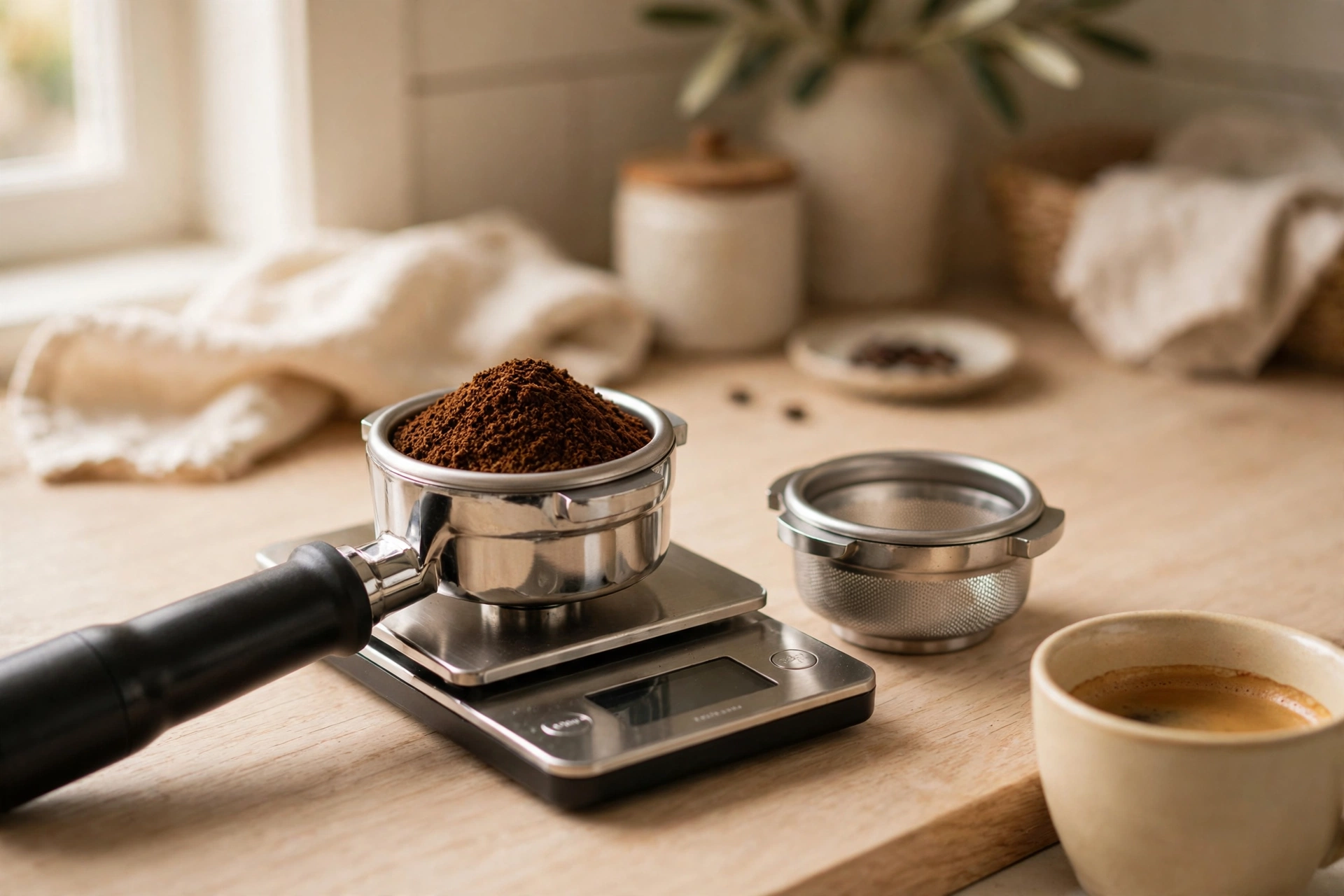
Dose is the weight of dry coffee you put in the portafilter basket, measured in grams before you add any water.
It is one of three linked numbers:
- Dose: coffee in — for example, 18g or 20g
- Yield: espresso out in the cup — for example, 36g or 40g
- Ratio: dose compared to yield — 18g to 36g and 20g to 40g are both a 1:2 ratio
That last point is the key to this whole question. If you compare 18g in / 36g out against 20g in / 40g out, you have not really changed the recipe. You have made a slightly bigger version of the same recipe. If you compare 18g in / 36g out against 20g in / 36g out, you have changed the recipe — the second shot is more concentrated and will extract differently.
For the full framework of dose, grind, and yield working together, see how to dial in espresso.
What changes when you go from 18g to 20g
1. You get a bigger, slightly stronger-feeling drink — if everything scales
At the same 1:2 ratio, a 20g dose gives you about 40g of espresso instead of about 36g. That is simply more drink in the cup: roughly 11% more liquid, made from 11% more coffee.
Taste-wise, it often feels a touch fuller — not because extraction is magically better, but because there is more of it. In a milk drink that extra volume is easy to lose; in a straight espresso you may notice it, but neither is clearly better at the same ratio.
2. Your basket fills differently — and that part really matters
Baskets are built for a range, not an exact number. A basket sold as an 18g basket will usually handle roughly 17g to 19g comfortably, depending on the coffee. A 20g or 22g basket gives you more room.
Dose has to fit the basket you own:
- Too little coffee in a large basket: you get excess headspace — the gap between the puck and the shower screen. The puck can expand, shift, and break up more easily during the shot, which can lead to uneven flow and a thinner, muddier result.
- Too much coffee in a small basket: the puck presses against the shower screen before or during extraction. You may see a clear screen imprint on the dry puck, struggle to lock in the portafilter, and get choking or uneven flow because the coffee has nowhere to expand.
- In range: the tamped puck sits below the screen with a small, sensible gap, locks in cleanly, and stays intact.
Dark roasts take up more volume than light roasts at the same weight, so 20g of a dark roast can overfill a basket that handles 20g of a light roast easily. Most real-world problems here are not about taste — they are about dosing 20g into an 18g basket, or 18g into a deep 21g basket, and fighting the hardware.
3. Flow changes — so grind usually has to change with it
A deeper puck offers more resistance. All else equal, moving from 18g to 20g in the same basket will usually slow the shot a little. Moving down from 20g to 18g will usually let it run a little faster.
That means dose and grind are not independent. Raise dose without changing grind or yield and you should expect a slower, possibly more bitter shot — not because 20g is bitter, but because you changed resistance and extraction at the same time.
As we covered in espresso grind size: what “fine” actually means, small changes matter. Dose is the same: change it on purpose, then adjust grind in one small step if the time and taste tell you to.
What does not change very much
If you keep the ratio, grind quality, distribution, and basket fit consistent, these differences are modest:
- Sweetness and balance: driven far more by ratio, grind, and bean freshness than by 18g vs 20g alone.
- Sour vs bitter problems: a sour 18g shot does not become balanced just by dosing 20g at the same yield. It usually becomes a sour shot made with more coffee. Fix extraction first.
- Crema: a bigger dose may produce a little more, but crema follows freshness and ratio more than a 2g change. More crema is not proof of a better shot.
In other words, dose sets the size and the starting resistance of the shot. It does not rescue a bad grind or stale beans. If grind quality is the weak link, our guide to the best espresso grinders under $200 is the place to fix it.
So which should you use?
Start with what your basket is designed for. If your double basket is an 18g basket and your shots fit cleanly, taste balanced at 18g in and about 36g out, and lock in without a screen imprint — stay at 18g. There is no prize for moving to 20g.
Use 20g if one of these is true:
- Your basket is a 20g or larger basket and 18g leaves it visibly under-filled, with a wet, broken-up puck after the shot.
- You consistently want a slightly larger double — for splitting into two cups, or for a milk drink where a 36g shot gets lost.
- A specific coffee tastes thin at a 1:2 ratio and you want to try a more concentrated version on purpose — for example, 20g in and 36–38g out — knowing you are changing the ratio, not just the size.
Use 18g (or go lower) if:
- Your basket overfills at 20g, especially with dark roasts.
- You make several test shots while dialing in and want to waste less coffee per attempt. Two grams saved per failed shot adds up over a bag.
- You prefer smaller drinks or lower caffeine per shot, all else equal.
Neither number is more “correct.” Competitive and cafe recipes use a wide range — roughly 18g to 22g for a double — because baskets, drinks, and coffees differ.
How to switch doses without confusing yourself
If you want to test the other dose, do it cleanly:
- Change only the dose first. Keep the same beans, same ratio target, and same grind for the first test shot. For 20g, aim for about 40g out if you were aiming for 36g out at 18g.
- Check the fit before you pull. Tamp, lock in, remove, and look. A deep screen imprint on the dry puck usually means you are over-filled for that basket and coffee.
- Time and taste the shot. If it runs noticeably slower and tastes heavier or more bitter, go one small grind step coarser. If it runs faster and thinner after a dose decrease, go one step finer.
- Compare at the same ratio first. Only after that should you experiment with changing yield as well. If you change dose, grind, and yield in one shot, you will not know what helped.
- Write it down: dose, yield, time, and one word for taste. Two test shots with notes teach you more than a week of guessing.
Give any change at least two shots before you judge it. The first shot after a change often carries old grounds from the grinder chute and does not show the new setting cleanly.
The bottom line
Yes, dose size matters — but mainly through basket fit, drink size, and resistance, not because 20g is inherently better than 18g.
At the same ratio, 18g in / 36g out and 20g in / 40g out are close cousins: the second is just a bigger drink. The shots that taste dramatically different are usually the ones where dose changed and the basket was wrong, the yield stayed fixed, or the grind was never adjusted.
Pick the dose your basket handles cleanly, keep your ratio consistent, adjust grind in small steps when you change dose, and let taste — not a number someone else uses — decide whether you stay there.