
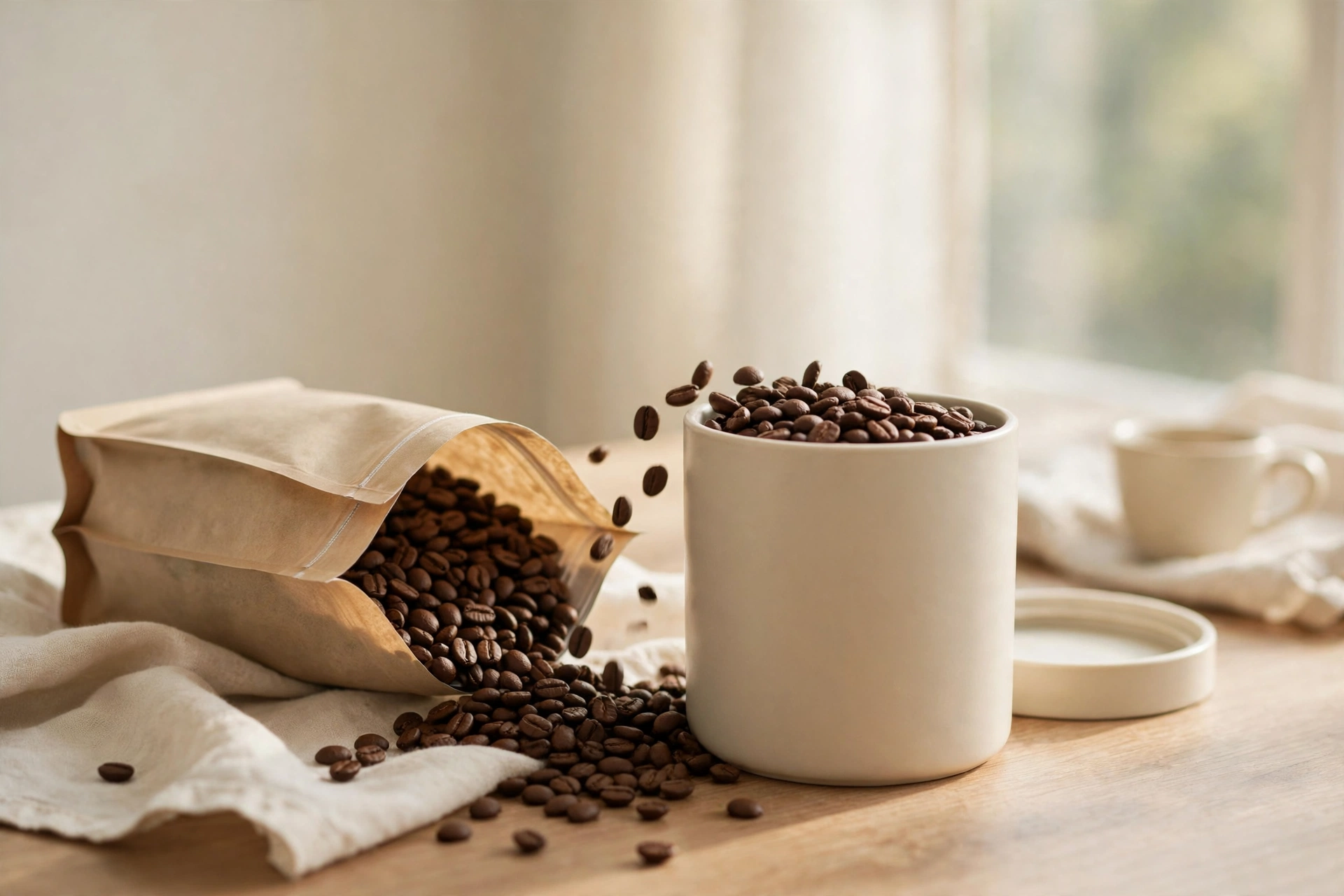
Fresh beans can taste flat in a week if they sit in the wrong place. Stale beans are one of the most common reasons home espresso turns sour, thin, or inconsistent — and it is rarely the machine’s fault.
Storage will not rescue beans that were old when you bought them, and it will not keep beans at their peak forever. What good storage does is slow the loss, so the bag you opened this week still makes a balanced shot next week. For espresso that matters more than for most brewing methods, because espresso extracts under pressure in about 30 seconds and shows every flaw in the coffee.
Why espresso is so sensitive to stale beans
When coffee is roasted, it releases carbon dioxide for days afterwards. In the first few days there is often too much gas — shots can run unevenly and taste sharp. Then beans settle into a window where they extract evenly and taste sweetest. After that, oxygen does the damage: aromatics fade, oils oxidize, and the coffee loses sweetness.
You can see it in the shot. Beans in their window produce a steady flow and hazelnut-colored crema that holds. Older beans often run faster, blond early, and produce thin, pale crema that disappears quickly. The taste follows: less sweetness, more sour or papery flatness, and a finish that drops away.
That is also why dialing in feels harder with old beans. You grind finer to slow the shot, it helps for a day, then the beans fade further. If you are chasing the same beans every morning, check their age before you blame your technique. The framework in how to dial in espresso only works when the coffee itself is reasonably stable from shot to shot.
The four things that age beans fastest
Good storage is mostly about keeping four things away from your beans:
- Air (oxygen): the main cause of staleness. Every time a container opens, fresh air gets in.
- Moisture: beans absorb water and odors from a humid kitchen. Humidity also changes how they grind.
- Heat: a warm spot — above the espresso machine, next to the oven, in sunlight — speeds up aging.
- Light: direct sunlight breaks down the aromatic compounds that make espresso taste like more than bitterness.
Keep those four low and you have solved most of storage. Most arguments about containers are really arguments about them.
The best place to keep beans at home
Keep beans in a cool, dark cupboard or pantry, away from the oven, dishwasher steam, and a sunny window. Not on top of your espresso machine — that surface gets warm every time the boiler cycles.
Room temperature and stable is the goal. A closed cupboard on an interior wall beats a fancy container left in direct sun. Keep beans away from strong-smelling foods, too. Coffee absorbs odors, so a bag next to spices or cleaning products can pick up flavors you do not want in the cup.
Should you keep beans in the original bag?
Often, yes — at least for the first week or so after opening.
Many specialty bags are designed for storage: a one-way valve lets carbon dioxide escape without letting much air back in, and a resealable closure limits airflow. If your bag has a valve and seals well, squeeze out excess air after each use, reseal it firmly, and store it in that dark cupboard.
Move beans to another container only if the bag does not seal, is torn, or is clear and lets in light. When you do, use an opaque, airtight container with as little empty space as practical. A container that is far too large leaves a large pocket of air with the beans every time you close it.
Whatever you use, follow these habits:
- Only open one bag at a time if you can. Two half-used bags age faster than one bag you finish first.
- Press out excess air before you seal, without crushing the beans.
- Open the container once a day at most, ideally just when you dose.
- Do not return ground coffee to the container. Once ground, coffee ages in minutes to hours, not days. Grind only what you need — the difference is covered in whole bean vs pre-ground coffee for espresso.
Airtight does not need to mean vacuum-sealed every day. A clean, dry, opaque container with a tight lid, kept reasonably full and opened briefly, is enough for beans you will use within a few weeks.
How long do beans stay good for espresso?
There is no single expiry date, because roast level, packaging, and storage change the timeline, but a practical guide is:
- First 3–5 days after roasting: often still degassing heavily. Some coffees, especially lighter roasts, taste better after 7–14 days of rest. If shots taste sharp and uneven despite good technique, the beans may be too fresh, not too old.
- About 1–4 weeks after roasting: the usual sweet spot for most medium roasts, provided the bag stayed sealed until you started using it and you store it well after opening.
- After opening: aim to finish the bag within about 2–3 weeks. Flavor will not fall off a cliff on day 22, but sweetness and crema will be noticeably thinner by the end of a month open on the counter.
- Unopened bags: they hold better than opened bags, but they are not frozen in time. Buy amounts you will use in the next few weeks rather than stockpiling bags for months.
Dark roasts tend to show age sooner — their oils sit on the surface and oxidize faster. Lighter roasts often rest longer and hold a little longer, but they are not immune.
Write the roast date on a piece of tape on the container. “Is this bag old?” is much easier to answer when the date is in front of you.
Should you freeze coffee beans?
Freezing can work, but only if you avoid moisture — and for most people drinking through a bag in two or three weeks, it is unnecessary.
Freezing helps in one situation: you have more fresh beans than you can use in their sweet spot, and you want to pause aging rather than watch them fade in the cupboard. If you freeze, do it properly:
- Freeze in single portions or one-week amounts, in truly airtight, moisture-proof bags or containers, with as much air removed as you can manage. A large bag you open every day defeats the point — each opening brings condensation and fresh air.
- Freeze once, thaw once. Let a portion come fully to room temperature while still sealed, then open it and use it over the next days. Do not refreeze thawed beans.
- Keep frozen portions away from strong freezer odors, for the same absorbency reason as the pantry.
Done this way, freezing slows staleness far better than a refrigerator. Done casually — one big bag opened daily from the freezer — it usually makes things worse.
Why the refrigerator is a bad idea
Refrigerators combine almost everything beans dislike except heat: high moisture, constant odors, and condensation every time a cold container opens in a warm kitchen. Beans come out flat and sometimes faintly tasting of whatever else was in the fridge. Keep espresso beans out of the fridge.
The same logic applies to leaving beans in a grinder hopper for weeks. A hopper is convenient for a day or two, but it is usually clear, warm from the machine nearby, and not airtight. Dose from the bag or container each morning, and keep only what you will use that day in the hopper.
A simple routine that works
- Buy beans with a roast date, in a quantity you will finish within about three weeks of opening.
- Rest very fresh beans a few days if shots taste gassy and sharp.
- Store the open bag — well sealed, air pressed out — or an opaque airtight container in a cool, dark cupboard away from heat and steam.
- Grind whole beans right before each shot; never store ground coffee for espresso.
- Label the bag with roast and opened dates, finish it before opening the next, and freeze only surplus, in sealed single portions.
The bottom line
Store coffee beans for espresso cool, dark, dry, and sealed, and use them in their window — roughly a few weeks after roasting, and within two to three weeks of opening.
Skip the fridge, keep beans off the warm top of the machine and out of sunlight, do not leave them sitting in the hopper, and grind only what you need. Those few habits will do more for consistent, sweet espresso than any special container bought to fix beans that were already stored badly.